Janet Hodgson and the Enfield Poltergeist: What Really Happened to Her

Janet Hodgson and the Enfield Poltergeist: What Really Happened to Her
Janet Hodgson was the girl at the center of the most documented paranormal case in British history. But the adults in the room were so busy watching for flying Lego bricks that they didn't see the abuse right in front of them.
🎙 Listen to the full episode: This post accompanies the Enfield Poltergeist deep dive—part four of the Warrens' True Paranormal Case Files deep dive series.
Quick Note: I've been using em dashes since I was 12—a very long time before AI and ChatGPT. You can pry them from my cold dead hands. :) I repurposed my script for the Enfield Poltergeist podcast episode and made it into a blog post, but the episode has much more information. Thanks for reading!
Who Was Janet Hodgson?
Janet Hodgson was the second oldest child of Peggy Hodgson, a single mother raising four children at 284 Green Street, Enfield—a council house in Brimsdown, north London. In late August 1977, Janet was eleven years old and dreading the start at a new school the following week. The family had lived in the house for thirteen years without any unusual activity.
Then, on 31 August 1977, Peggy called 999. And the rest is literal paranormal history.
What followed became the most documented case of alleged paranormal activity in British history—140 hours of tape recordings, 180 visits to the house, and twenty-five all-night vigils by two investigators from the Society for Psychical Research. Janet was at the center of nearly all of it.
If you've seen The Conjuring 2, you may think you already know this story. You don't. The Warrens visited the Hodgson home uninvited for approximately a few hours to four days at most—arriving eight months into the investigation, with most of those days occurring after the activity had died down. None of the Hodgsons even recalled meeting them prior to the press junket for The Conjuring 2. This is Janet's story, not theirs.
What Janet Hodgson Claimed Happened to Her
The activity began with knocking sounds on the walls—four distinct taps, then silence. WPC Carolyn Heeps, the police officer who responded to Peggy's 999 call at approximately 1:00am, went on record and on camera asserting that she had seen a chair slide across the floor and heard unexplained knocking in the house. Her uniformed testimony added considerable public weight to the family's claims from the very beginning.
In the days that followed, the alleged activity escalated dramatically. Marbles and Lego bricks catapulted around the room as if launched by invisible trebuchets. The settee in the living room was upended. A local priest blessed the home, yet the activity only intensified. The chaos was always worst right at bedtime.
According to investigators Maurice Grosse and Guy Lyon Playfair from the Society for Psychical Research—who arrived after The Daily Mirror called them in—Janet specifically reported:
- Being bodily ejected from her bed night after night
- Being forcibly thrown through the air
- Multiple curtains in the home wrapping themselves around her neck to strangle her
- The settee levitating off the floor
- Speaking in a voice she claimed she had no control over, which came from the back of her neck
Janet also started at one point trying to explain the activity as the ghost of a young girl who had been murdered by her own father. For a while, everyone involved referred to the poltergeist as a female spirit. It would later switch between approximately a dozen different names before settling on one.
Janet Hodgson and "Bill Wilkins": The Voice That Convinced the World
In December 1977, Grosse told Janet within earshot that "all I need is the voices to talk." That same night, Janet began speaking in a deep, gruff voice with a thick cockney accent for the first time.
Before the voice landed on the name "Bill," it cycled through a remarkable number of identities—Joe Watson, Fred, Tom, Dirty Dick, Andrew Gardner, Stuart Certaint, Mrs. Haylock, Bill Haylock, Mrs. Oakland, Charlie Brown, Zebedee, Ralph, Claude, Barney, and more—occasionally barking like a dog throughout. Eventually the voice settled on Bill Wilkins and largely stayed there.
"Just before I died, I went blind. Then I had a haemorrhage and I fell asleep and I died in the chair in the corner downstairs." — Janet Hodgson, speaking as "Bill Wilkins"
This claim became the nail in the proverbial coffin for many people on the fence about the case. As it turned out, a Bill Wilkins had lived and died at 284 Green Street. His son, Terry Wilkins, confirmed his father had died sitting in a chair in the house.
Here is what the mainstream coverage reliably omits: Bill Wilkins was only 61 when he died—not 72, as Janet claimed. And his death certificate listed a heart attack (specifically, a coronary thrombosis)—not a haemorrhage. Terry Wilkins said it didn't sound like his father, who had been a quiet man. Bill Wilkins was described by an acquaintance as a generous and respectable man who did not use foul language—which is worth noting, because the "Bill" voice was rude and vulgar and sounded nothing at all like how the girls normally spoke.
Ray Alan, a famous ventriloquist, visited the house and concluded that Janet's "Bill" voice was just a vocal trick. American magician and ardent skeptic Milbourne Christopher—who had investigated and debunked several poltergeist cases—traveled to Green Street, was unimpressed, and even caught Janet trying to sneak down the stairs after she had pretended to go to bed. He stated that the poltergeist was "nothing more than the antics of a little girl who wanted to cause trouble and who was very, very clever."
The photographs
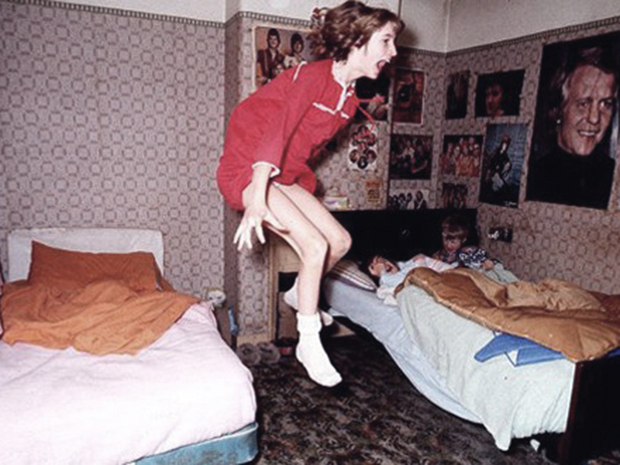 The famous photographs of Janet appearing to levitate—or be bodily thrown—from her bed are, on closer examination, a burst sequence of shots showing a little girl jumping out of bed. The way her hair and nightgown move, the poses she makes: it is a series of photographs of Janet jumping from her own bed. The people who wanted to believe did. And do. Not that there is anything wrong with that.
The tape-over-the-mouth experiment
Grosse tried taping Janet's mouth shut to see if she could still produce the "Bill" voice. His own records describe the first results as "subdued." When he instead had Janet hold water or cold tea in her mouth, she nearly choked trying to speak and made only a few grunts after spitting the water out. It is also worth noting that Milbourne Christopher successfully replicated Janet's results using a ventriloquist's technique.
And yet, some witnesses claimed the "Bill" voice was heard with total clarity—as if her mouth had never been taped or filled with water at all. Our minds are way more powerful than we give them credit for.
What the Adults Kept Missing: Janet as a Child in Distress
Grosse and Playfair recorded around 140 hours of tape and made a minimum of 1,000 combined hours of investigation. In multiple recordings, you can hear Grosse angrily berate Janet and Margaret when the poltergeist activity doesn't go exactly to plan. The Hodgson kids, whose own father was absent and had apparently been abusive when he had been there, had started to see Grosse—and perhaps Playfair—as father figures. And like their father, Grosse's affection was conditional. Specifically, conditional upon the quality of the paranormal hijinks.
Grosse only took up paranormal investigation after the tragic loss of his own daughter—also named Janet—at the age of 22 in a motorcycle accident. Within one month of her death in August 1976, he joined both the Society for Psychical Research and The Ghost Club. He did insist, right up until his death, that losing his daughter hadn't clouded his judgment. But the pattern of his behavior throughout this case tells a different story.
"Janet's expression gave the game away at once, though I said nothing about the incident... The fact that I had spotted the trick at once encouraged me to think I would have spotted earlier tricks, had there been any." — Guy Lyon Playfair, This House is Haunted
Janet and Margaret were caught on multiple occasions playing tricks. Grosse and Playfair both reported this but were largely unbothered by it, dismissing those occasions as the girls just seeing what they could get away with—even reasoning that catching them trickery made all the other times somehow more likely to be genuine. The sunk cost fallacy played a role. But it was more than that: if the poltergeist activity were to stop, Grosse and Playfair would leave. Just like Janet's father had.
And what, like it's hard? They didn't have iPads back then. The only video game in any home at that point was Atari's HOME PONG—nearly $600 in today's money, which a single-parent family in a council house certainly wouldn't have. Janet had loads of time to hone her craft, and all the adults constantly underestimating her just made her job even easier. The Hodgson children's one shared television—notably the only item in the home that went entirely unharmed throughout the entire period of alleged poltergeist activity—was the best form of escape available to them.
Investigators also found, inside the Hodgson home, a torn-out magazine article all about Matthew Manning—a then eleven-year-old boy in Cambridge whose poltergeist case in 1967 was called "one of the most extraordinary outbreaks of poltergeist phenomena" of the twentieth century, and who had gone on to bend spoons like Uri Geller on television. Janet had that article. She had read it. She had clearly found it interesting.
Johnny Hodgson: Janet's Brother Nobody Talks About
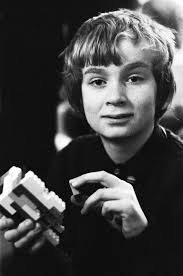 Most sources gloss over Johnny Hodgson, who was a year younger than Janet. At most, you'll hear that he was away at boarding school and barely hear another word about him. But Johnny stands out in this case for several reasons.
Johnny had been sent to Wavendon House—a residential school for maladjusted boys, a boarding facility for up to 50 boys aged 7 to 16—when he was about 7 years old. That was approximately three to four years before the poltergeist activity began. In the 1970s, "maladjusted" could mean anything considered abnormal: phobic and anxiety states, bed-wetting, dishonesty, nervous eczema, asthma, or sexual difficulties. A good chunk of boys at these schools may have been on probation from juvenile court. Children with unrecognized and untreated ADHD would likely have ended up there too.
Notably, it appears that Johnny was sent away the same year that Mr. Hodgson left the family—though which came first has proven impossible to confirm. The two events may well be connected.
Playfair wrote that a local child welfare psychiatrist had apparently been responsible for having Johnny sent away, and that neither the psychiatrist nor anybody else had ever explained to Peggy Hodgson what Johnny's problem was. All she knew about psychiatrists was that one of them had taken her eldest boy from home.
Johnny did return to Green Street during holidays and some weekends—and the activity would sometimes get much more chaotic when he was home, to the point where Peggy admitted being anxious about him being there. Janet, as an adult, said that Johnny was "just a handful" and that was why they sent him away. Whether it was really that simple, nobody now can say.
Johnny Hodgson is not listed in the credits for any of the documentaries or for The Conjuring 2. He died at only 14 of an unspecified type of cancer. He was barely there in the story. And then he was gone entirely.
⚠ Content warning The section below discusses childhood sexual abuse. Please read with care.
The Darkest Part of Janet Hodgson's Story
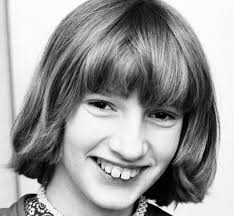 There is something in this case that mainstream coverage has consistently failed to address—something that, once you see it, you cannot unsee.
According to Grosse and Playfair's own records, Janet's father was mentally disturbed and had needed medical treatment for a mental condition. When Mr. Hodgson was 15, he was convicted of child molestation—something he apparently told Janet and Margaret about.
Playfair stated on tape that he thought Janet may have suffered a sexual attack in Durrants Park graveyard, where she had been beaten quite badly.
And then there is the content of the "Bill" voice itself—content that does not appear in mainstream coverage of this case. The voice was heavily and disturbingly preoccupied with sex. Bill asked David Grosse (Maurice's son) why big girls get periods and why men wore that plastic thing when in bed with a woman. The full context for the famous soundbyte—Janet saying in her Bill voice, "I'm invisible because I'm a GHOST"—is that Bill had claimed he was on top of Janet, and nude. Grosse asked why Janet couldn't feel him.
A child being preoccupied with sexual themes is a recognized sign of sexual abuse. And there are studies that show sexual trauma may be an important contributing factor in the development of psychosis.
What Janet needed was help. Instead, her home and life were turned into a circus.
 Janet was very likely a victim who never got the support she needed.
As I’m all about the reduction of harm when it comes to the supernatural, whether that harm is strangers on Reddit replying to people’s paranormal stories confidently claiming that the OP has demons, or whether it’s paranormal investigators who should have realized they were just making things worse, I really wish things had gone differently for the Hodgsons.
Sometimes, the scariest part of a story isn’t the unexplained or supernatural part. Sometimes, the scariest part is just humans. Belief in the paranormal can get dangerous when we dismiss any naturalistic or mundane explanations—such as in the case of Janet, focusing on alleged poltergeist activity instead of acknowledging the abuse she may have suffered through.
And just to bring this back to the focus of this series right at the end, though the Warrens were barely involved, you just know they can’t resist a paranormal circus. Even though they were only there for a couple days, they still took credit for the investigation not just in their book, The Demonologist, but in The Conjuring 2. Ed did what he promised Playfair and the Hodgson family: they made a lot of money on this story.
Unfortunately for him, he couldn’t spend any of it. He died 10 years before the movie came out.
Frequently Asked Questions About Janet Hodgson
Who is Janet Hodgson?
Janet Hodgson was the eleven-year-old girl at the centre of the Enfield Poltergeist case, which began on 31 August 1977 at 284 Green Street, Enfield, London. She was the second oldest child of single mother Peggy Hodgson and became the primary focus of the 1977–1978 paranormal investigation by Maurice Grosse and Guy Lyon Playfair of the Society for Psychical Research.
Where is Janet Hodgson now?
Janet, born in 1965, has moved on from the experience, and generally avoids discussing the events that happened in 1977-1978. She has been quoted saying, "I haven’t done many previous interviews because it brings back all the emotions that I’ve tried to escape... You never feel like you’re free of it... It’s never left me." Janet Hodgson married and changed her name to Janet Winter. She is private and avoids the public eye, except for the occasional interview, the press tour/junket for The Conjuring 2 in 2016, or notably her involvement in the Apple TV documentary The Enfield Poltergeist. She still lives in England, but no longer lives in the Enfield house.
What did Janet Hodgson claim about the Enfield Poltergeist?
Janet claimed she was repeatedly bodily ejected from her bed, thrown through the air, and that curtains wrapped around her neck. She also began speaking in a deep, gruff voice she said came from the back of her neck and which she had no control over—a voice that eventually identified itself as Bill Wilkins, a man who had previously lived and died in the house.
Was Janet Hodgson faking?
Janet and Margaret were caught playing tricks on multiple occasions by the investigators themselves. Famous photographs of Janet "levitating" are, in burst sequence, clearly a girl jumping from her own bed. Skeptical magician Milbourne Christopher described the case as "nothing more than the antics of a little girl who wanted to cause trouble and who was very, very clever." The adults around her consistently underestimated what a determined, devious, and entirely dedicated child is capable of—and that made her job considerably easier.
Who was Bill Wilkins?
Bill Wilkins was a man who had previously lived and died at 284 Green Street. Janet, in her "Bill" voice, claimed he had died of a haemorrhage, aged 72, in a chair downstairs. Records show he was actually 61 at the time of his death, and his death certificate listed a coronary thrombosis—a heart attack, not a haemorrhage. His son Terry said it didn't sound like his father, who had been a quiet man who did not use foul language.
What happened to Janet Hodgson's brother Johnny?
Johnny Hodgson was sent to Wavendon House—a residential boarding school for maladjusted boys aged 7 to 16—when he was approximately 7 years old, before the poltergeist activity began. He is rarely discussed in mainstream coverage of the case. He died at only 14 of an unspecified type of cancer and is not credited in any of the documentaries or in The Conjuring 2.
Was Janet Hodgson sexually abused?
Investigator Guy Lyon Playfair stated on tape that he believed Janet may have suffered a sexual attack. Her father had been convicted of child molestation when he was 15—something he apparently told the children about. The content of the "Bill" voice was heavily and disturbingly sexual in ways not reflected in mainstream coverage. A child being preoccupied with sexual themes is a recognized sign of sexual abuse, and this aspect of the case was never adequately addressed by the adults around her.
Did the Warrens really investigate the Enfield Poltergeist?
Ed and Lorraine Warren visited the Hodgson home uninvited for approximately a few hours to four days, arriving eight months into the investigation and spending most of that time there after the activity had already died down. None of the Hodgsons recalled meeting them prior to The Conjuring 2 press junket. Playfair said of the Warrens that "they just wanted to make money out of it." Ed was quoted saying directly to Playfair, "We could make a lot of money." The Conjuring 2 earned $321.8 million at the box office. Ed Warren died ten years before it came out.
Where Is the Annabelle Doll Now? Has Annabelle Escaped?