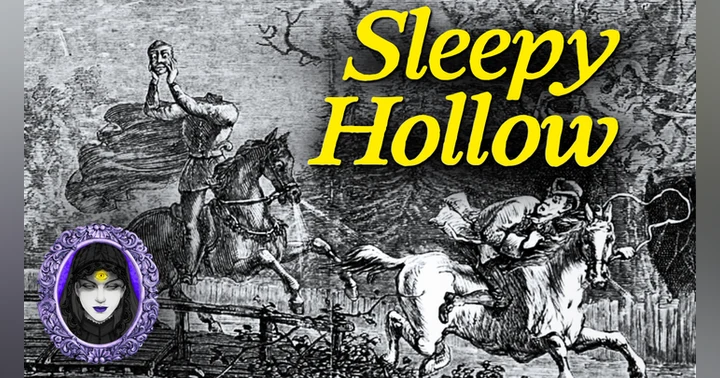
The Legend of Sleepy Hollow AKA Brom Bones Apologists Anonymous | Halloween Strangedive | Ep #43


 Apple Podcasts

 Spotify

 YouTube

 Castbox

 PocketCasts

 Amazon Music

 iHeartRadio

 Podcast Addict
Join Madame Strangeways for this deep dive into the Legend of Sleepy Hollow by Washington Irving. Learn about the spooky history, culture, and weird folklore surrounding the classic American ghost story of Ichabod Crane and the Headless Horseman himself.
And also, happy Strangetober! If you're listening to this to get into the spooky season and set the mood for Halloween, welcome!! Follow the podcast to hear more true scary ghost stories and strange stories of the unexplained.
Remember, Strangers & Strangelings & Strangecetera: you can feel afraid and not be in danger.
❤ A huge, spooky thank you to my Patrons! TJ Hodder, Gmanmusic, Ted, Keith, & Tori! ❤
➽Join My Patreon! Get an EXCLUSIVE sticker/decal to put on your water bottle or whatever! Also get your name read at the beginning of every episode! Also access to a guided sleep meditation and exclusive bonus content! Wow! Golly gee willikers! Join today at: https://www.patreon.com/madamestrangeways
➽ Send Me Your Thoughts or Theories on the Ghost Stories in this Episode and I may share them on a future episode: madamestrangeways@gmail.com
➽ Submit Your Own Strange Story: madamestrangeways.com or madamestrangeways@gmail.com
➼ Follow me on Instagram at @madamestrangeways
➼ Subscribe to my YouTube: @madamestrangeways
➼ Buy me a coffee: https://ko-fi.com/madamestrangeways
Produced by: Madame Strangeways
♫ Theme Music by: Marina Ryan at marinamakes.co
Cover artwork by: Andrea Giselle Roldán at @cultofteddy
Every true strange story narrated in this podcast was read with permission from the original author.
Follow the podcast and explore strange, spooky and true paranormal stories as narrated by Madame Strangeways.
0:02 So to keep her company, Rupesal turns the turnips into her friends and acquaintances. Oh, that's kind of nice actually. As the turnips wilt after a little while, as turnips are want to do, so do the persons that were created by Rupesal's magic. Oh, that's not good. Welcome stranger to a special Halloween episode of Madam Strangeways with me. Madam Strangeways. Now usually I share your true strange stories and give my own strange commentary along the way, but on this very special, very strange sawin spectral spect. Oh, Spect.
0:49 Spooktacular. Strangtacular. Join me for a deep dive into the first Great American ghost story, The Legend of Sleepy Halloween. Follow by Washington Irving. First, we'll discuss the strange history and folklore surrounding the story. And of course, I will be dragging you down. Some. Strange rabbit holes along the way, obviously. And then at the end I'll narrate an abridged version of The Legend of Sleepy Hollow just for you. But before we get started, a strange shout out to my Patreon patrons TJ Hotter of the Tapes of Trepidation podcast, G Man Music. Ted, Keith and Tori, thank you so much to my Feral Fiendish 5 for supporting the show. If you would like to hear your name at the beginning of every episode and get a free sticker while you're at it, join the Patreon today at patreon.com/madam Strange Ways. And now on to this bizarro Halloween strange dive on The Legend of Sleepy Hollow, here on Madam Strange Ways. Happy strange tober everyone.
2:13 I hope everyone's having a fantastically strange, strange tober. We are so close to Halloween or strange a ween. You know, you could call it strange a ween like that might be cool. You think that's can we can we make that happen? Can we make fetch happen? Let me know. Anyway, I hope you're having a very strange, strange tober. And of course, as you know, in the strange verse, which is where you are right now, strange is good. So it's a good thing. I hope that you're having a pleasantly strange strange tober. We're just going to go ahead and just jump face first. Oh, head first, headless. Hmm. Hmm. Something we're going to, you see where I'm going. We're going to jump in head first, or headlessness first into the Legend of Sleepy Hollow. But really quickly, I want to thank Keith, my patron. Keith, for the suggestion of today's topic because I wouldn't have even thought about doing the story, an episode on the Legend of Sleepy Hollow.
3:08 So thank you, Keith. But also, if you're listening and you have an idea for a story, if you have an idea for just a future topic that I could talk about, let me know. e-mail me madamstrangeways@gmail.com because it could be the next episode. Who knows? You'll never know until you try. OK, so here we go. The Legend of Sleepy Hollow published over 200 years ago, in 1819 and 1820. So if you do your own research, you're going to find both years, but both are right. But the earliest time of publication was 1819. The Legend of Sleepy Hollow was considered the first Great American ghost story and actually just kind of the first good, like, passable American story period.
3:51 Because remember, this isn't that far removed from the American Revolution. And I think in the UK they kind of consider it the American rebellion. And they were still kind of exalty about it at the time. So they didn't really think that any Americans were very good at writing. And then Washington Irving came around and they had to go. You know what? This guy's on to something with this Headless Horseman situation. So Washington Irving, who lived from 1783 to 1859, published The Legend of Sleepy Hollow in 1819 as a part of a collection of stories titled The Sketchbook of Jeffrey Crayon. Jeffrey spelled, of course, Geoffrey. And what does that even mean?
4:37 But don't I can't get ahead of don't put a pen in that. We're going to come back. Who's Jeffrey Crayon, you may ask, because I also wondered. We're going to get to it. Keep keep your. Hmm. What's a Halloween hat? What kind of hat do you keep it on? Keep your Halloween hat on. OK. The Sketchbook of Jeffrey Crayon is what it was ublished in. Also included in that book was the classic tale Rip Van Winkle. Yeah, he did that one too. Isn't that interesting? They're both in the same book. Both super iconic, Irving is often considered the first Great American writer, so you're probably at least passingly familiar with the story of The Legend of Sleepy Hollow, either from the Disney animated short or from the Johnny Depp and Christina Ricci. Why did I say it that way?
5:22 Christina Ricci movie spoiler alert The gist of the story in case you haven't. In case you don't know the story of the Why do I keep saying the story of the Legend of Sleepy Hollow? That's what this episode needs to be called is the story of the Legend of Sleepy Hollow. Anyway, the story spoiler alert is that a weirdo named Ichabod Crane gets chased by this headless man on a horse. That's, that's, that's the gist of it. I don't know how else to to wrap it up for you, but we're going to get into a little plot review in just a second, just to remind everyone all the, all the, all the beats that happened in the story. But first, like I said, you've probably seen the Disney film or maybe you've seen Sleepy Hollow, which was the Tim Burton film, but there's also a bunch of other adaptations. So here we go.
6:13 In 1922. The first adaptation was The Headless Horseman, a silent film who starred Will Rogers as a lanky Ichabod cream. It was kind of funny. It was supposed to be humorous and probably slapstick. I didn't. I didn't watch it. I was going to say slapstick. Ian, is that a word? We're going to go with that, I think. I think I like it. Anyway, 1949 is when Disney made the adventures of Ichabod and Mr. Toad. We'll find out in just a moment. Why are why why why are those connected? 1999 Sleepy Hollow with Johnny Depp and Christina Ricci and then in the early aughts ish, I don't remember. I didn't write this year down a show where Ichabod Crane was like a real person and he was frozen somehow for some reason and then thawed out in modern times to help solve mysteries. Because I assume the Headless Horseman is like back and presumably Ikapa is the only one that can defeat him, even though that's not how it worked in the story. I don't know.
7:14 It's a strange premise. Strange premise for a show. If you've seen it and you think I should watch it, madamstrangeways@gmail.com, let me know. Watch, watch. I watch it and then I get really into the show and I'm like the number one fan. Unlikely but possible. Stranger Things and all that, but the Disney cartoon was one of Disney's four package films quote UN quote so during World War 2, the studio Disney lost a lot of manpower and resources, which left Disney with countless unfinished ideas too long for shorts and too short for features. So Disney being as good at making money as it is, decided, oh, we'll just slap 2 together that don't make any sense and there's no reason for them to be connected otherwise, and we'll just put them together and then we'll have a feature length film.
8:00 Great. So that's what they did with three other films. So I think 4 total around that time. I just thought that was so interesting how World War 2 impacted even animation studios at the time. Pretty interesting. Anyway, what I remember specifically from the Disney cartoon, which I have not watched since I was a child, but I have this like vivid recollection of, of being in like the school library, like around Halloween, obviously. And then the librarian Wheeling out the big cart with the TV and the VCR and the VHS and then sitting all of us down. The lights go off. And I think it was probably even like, you know, an overcast day or something very spooky and then playing, you know, the movie for us. And I genuinely don't think I've seen it since then.
8:43 But what I remembered from watching it back then, if I had to tell you the plot, I guess I would say, OK. I guess I would say Ichabod Crane is the protagonist. He's a good guy, right. And then the Gaston looking guy whose name is Brahm Bones, we'll get into him later. The Gaston looking guy was kind of like not a great guy, but like not a good guy. And then obviously the Headless Horseman was the main bad guy, right? That's pretty much all I remember. And also how funny looking Ichabod Crane was made in the cartoon. That's all I really recall. But after all the reading that I have done for this episode, Ichabod's kind of a Dick. Like it's kind of a bad dude.
9:27 I wrote bad dude in my script. And then I just, you know what? I was like, that isn't strong enough. He's a Dick. I don't know what else to say. And it's on purpose. Like it's listen, you'll get, we'll get there. Anyway, we'll get into more detail about Ichabod Crane and the Headless Horseman and the history and the setting and Washington Irving himself. But first, let me just give you a little refresher on the story of the Legend of Sleepy Hollow Man. Also, if you can hear Thunder, that's not me. That's not me. Putting that in afterwards, that's natural. That's natural. I summoned the storm for the perfect amount of atmosphere for this episode, so you're welcome. OK, on to the plot.
10:13 So Ichabod Crane is a travelling school teacher. Yes, he looks almost exactly how they animate him in the Disney cartoon. It's Canon. Like they took like no creative freedom with his character. He looks exactly how he's described. So Ichabod is trying to court Katrina Van Tassel, which is this, of course, beautiful young 18 year old girl in the town. And he's trying to court her specifically because, and only because he knows that she's going to inherit a bunch of land and farms and orchards because her family are like rich farmers and they've got a lot of land. And Ichabod is trying to be a sugar baby. Ichabod is trying to find a sugar Mama. And so he sees Katrina Van Tassel and he's like, Yep, that's it.
10:59 So that's the only reason he's trying to court her, which is rude. This is why I'm saying he's kind of a Dick. So Ichabod gets an invitation to one of the Van Tassel's party, the Van Tassels, of course, being Katrina Van Tassel's family. So he's like, oh, oh, geez, OK, this is my chance. School's out, kids, fuck off. I got to go. This is way more important than your education. I actually don't care about you at all. I got to go. So he closes school down early and then he takes his weird. How do they describe it? A broken down plow horse named Gunpowder rides that horse. Poor Gunpowder rides Gunpowder out to the farm for the Van Tassel party. So at this party, everyone is telling ghost stories because everyone in Sleepy Hollow loves ghost stories. And Brom Bones, you know, guest on, tells a ghost story about the most famous ghost in Sleepy Hollow, which is the Headless Horseman.
11:53 You may have heard of him. So at some point in the night, off screen, Katrina Van Tassel ends up rejecting Ichabod. And he doesn't take it very well. And he sulks and he mopes his way home writing gunpowder. And when I say home, I should also say that he just lives with all the different farmers in the town. Like he just lives at different people's houses and moves around week to week. So he's on his way to whatever farm that he was staying at at the time. Anyway, on his ride home, quote UN quote, he starts getting perhaps understandably spooked because another rider on a horse has started to trail him on the ride home.
12:35 And this is like not that long after he was hearing a very, very scary story about the infamous Headless Horseman chasing people at night on his horse. Obviously, I feel like that's implied. Anyway, apparently it does turn out to be the Headless Horseman, who is now chasing Ichabod, and he stands up on his saddle as his horse is running, which is kind of cool. And then he throws his decapitated head at Ichabod and knocks him off of gunpowder, and Ichabod was never heard from again. Dun Dun Dun. But actually the book leaves it kind of vague. So it's kind of letting you decide. Was the Headless Horseman just Brom Bones pranking him, being kind of an asshole, but like, also he kind of deserved it, you know? Like I'm kind of on Brom's side here, honestly. Here's the thing.
13:23 It's like they're they're pairing the, or they're pitting the like the geek and the jock against each other. I don't normally vote for the jock. Normally I'm rooting for the geek, right? But in this case, Ichabod's kind of a jerk. So I'm kind of with Brom on this one. Anyway, the book lets you decide was it Brom Bones pranking him, or was it actually the Headless Horseman himself in the flesh, In the spectral flesh, but actually in the book, the man telling us the story. In the story, he heard that Ichabod ended up becoming an attorney and a politician and a Court Justice after fleeing Sleepy Hollow and leaving all of his belongings behind because he was so scared of what happened to him that night. But others in the story say that he was never seen or heard from again.
14:14 Of course, the Disney cartoon says that the Headless Horseman was definitely a ghost. Like, no question. So then why is Brahm even in this? Anyway, we're going to move on. That's the basic gist of the story. So now we're going to discuss Ichabod. Ichabod Crane himself. So actually he was named after a real person named Ichabod Crane that Washington Irving did actually meet in real life. So I saw in my research a few places that were saying, OK, this story, like the character's name is Ichabod Crane. So like, what's the meaning behind Ichabod and Crane? And I started going down that rabbit hole too, because apparently Ichabod is a name from the Bible.
14:55 And so like, I'm looking at like the the Bible references, I'm looking it up and I'm seeing what was his character Ichabod in the Bible. Is there some kind of connection here to the story? And like, Crane is apparently an antiquated way to refer to a tall, lanky man. And Crane was tall and lanky. So I was like, OK, I'm trying to put this together for the show, for my, for, for, for you. I wanted to be able to give you the most accurate information. But no, no, Irving just heard that this real man that he met, he heard the name Ichabod Crane, and he immediately wrote it down for a future story. He said, now that's a name. I mean, it's crazy. Irving had a very good, and by good I mean weird. And by weird, I mean strange taste in names. As you will come to talk about, you probably have already picked up on it.
15:45 Brom Bones, Ichabod Crane, Jeffrey Crayon, even his own name, Washington Irving. What is that? Anyway? We're going to do it more. Ichabod Crane's superstitious belief, you know, because he's easily spooked, right? Like on the on the ride back from the farmhouse, he's really spooked. And the reason that he's so easily spooked is that he always had his nose in a scary book such as The History of New England Witchcraft by Cotton Mather. But actually, there is no real book by that name, although Washington Irving could be alluding to Mather's memorable Providence's relating to witchcraft's and possessions, which is probably true because of course, back when this was written in 1819, you couldn't just Google it.
16:32 You couldn't just Google it. So I feel like it's close enough. So Mather, who wrote that book, was a Puritan minister and a prolific author, though best remembered for his role in the Salem witch trials, which were between 1692 and 1693, not very long. For as much as we talk about the Salem witch trials, they didn't go on for that long, not nearly as long as the European witch trials, which went gone from 1400 to 1775, in which 100,000 people were prosecuted for witchcraft in Europe and British America. Meanwhile, the Salem witch trials, 25 people, 25 people died. Why do we talk about the Salem witch trials so much?
17:12 It's kind of weird. Anyway, Mather, who wrote that book that Ichabod Crane is always reading, was a firm believer in witchcraft and the supernatural, and was an influential champion of such beliefs. O it's weird that Ichabod was reading that because in 1790, when the story is set, which I robably should have mentioned earlier, by the way, the story is set in 1790. We'll get to that in the settings section. OK? It's further down. Anyway, in 1790, people weren't thinking about witch trials anymore, and they definitely weren't as superstitious as he, the character Ichabod Crane is being. And he's supposed to be a school teacher, so why was he so superstitious? It's kind of weird and it feels like it feels like Irving was definitely doing it on purpose.
17:58 I wish that I were a smarter person that would be able to tell you kind of what he was going for there. But he's clearly trying to go somewhere because otherwise, why would you include that detail? I think it's fascinating detail and I think it makes him, if not a likable character, a very memorable 1. So I'm going to read you the actual description that Irving wrote of Ichabod crayon so you can see just what I mean when I say Disney took zero creative liberty with his character. Decide OK, here we go. The cognomen of Crane was not inapplicable to his person. He was tall but exceedingly link, with narrow shoulders, long arms and legs, hands that dangled a mile out of his sleeves, feet that might have served for shuffles, and his whole frame most loosely hung together.
18:47 His head was small and flat at top, with huge ears, large green glassy eyes and a long snipe nose so that it looked like a weather cock nice perched upon his spindle neck to tell which way the wind blew. To see him striding along the profile of a hill on a windy day with his clothes bagging and fluttering around him, one might have mistaken him for the genius of famine descending upon the earth or some scarecrow eloped from a cornfield. Like, that's so mean. So just to be clear, the real Ichabod Crane that this that that Irving met was, did not look like this.
19:29 He didn't look like this. He took the name. The real Ichabod Crane is like a general or something and the the Navy or the army, I don't remember. He's a real guy, but Ichabod Crane's looks were not based on him. So how rude was that description, though? See, see what I mean? You don't write a you're not writing a protagonist like that. Honestly, you're just not. But I'm here for it. All right? We're just going to stop very briefly on the character of Brom Bones. And I mean very briefly but I just had to highlight I love this fact. Brom Bones played pranks on Ichabod with his bro friends and trained a local dog to howl whenever Ichabod sang. Which apparently happened more than one might imagine because I guess Ichabod being the school teacher he would also He would also do a lot of stuff with church and he would like lead the psalms.
20:23 He would lead, you know, I don't know. I don't know, I don't know how church works, but he did a lot of stuff in his voice, saying a lot. And I guess Brahm trained a local dog to hell. Whenever Ichabod saying, I think that is so funny, Brahm. Hell yeah, Brahm. And when I say brief, that's honestly that's all I wanted to say because I really want to get into the Headless Horsemen because not only are we going to talk about the character in the book, we are also going to talk about all the other headless Horsemen that exists in other cultures. And I'm very excited to talk about it. So the Headless Horseman, I'll go ahead and open with the description from Washington Irving himself in The Legend of Sleepy Hollow, which describes the Headless Horseman. The dominant spirit, however, that haunts this enchanted region, Sleepy Hollow, and seems to be. Commander in chief of all the powers of the air is the apparition of a figure on horseback without a head. It is said by some to be the ghost of a Hessian trooper whose head had been carried away by a cannonball in some nameless battle during the Revolutionary War, and who is ever and Anon seen by the country folk hurrying along in the gloom of night, as if on the wings of the wind. His haunts are not confined to the valley, but extend at times to the adjacent roads, and especially to the vicinity of a church at no great distance.
21:44 Indeed, certain of the most authentic historians of those parts who have been careful in collecting and collating the floating facts concerning the specter, allege that the body of the trooper having been buried in the churchyard, the ghost rides forth to the scene of the battle in nightly quest of his head. And that the rushing speed with which he sometimes passes along the hollow like a midnight blast is owing to his being belated and in a hurry to get back to the churchyard before dark. What's a Hesse? And you ask, Put a pen in that. How many pins have we got? Are you keeping track? Let me know, mattofstrangeways@gmail.com. So the Headless Horseman was a fearsome spectre in the Legend of Sleepy Hollow.
22:27 And like I said, it's like the most famous ghost in Sleepy Hollow because they tell a lot of ghost stories. This is the most famous one. So the Headless Horseman wore all black and he had a Cape and also his horse was black. And by the way, Brom Bones horse was also black and Brom Bones horse was named Daredevil. Interesting. We'll find out more. OK, maybe I could have talked about Brom Bones more because I'm already thinking about more details that I could add. It doesn't matter, we're moving on. We're talking about the Headless Horseman. So what you may famously remember about the Headless Horseman is a pumpkin or a Jack O Lantern, especially as his head right, which is very scary. However, in Irving's time, a pumpkin was not yet a Halloween Jack O Lantern. Pumpkins didn't begin getting used for Jack O lanterns until the 1840s, after the Irish Potato Famine forced many Irish to immigrate to America purely so they wouldn't starve to death.
23:23 And then they found the native pumpkins to be much easier to carve and use as lanterns than the traditional turnip used in Ireland. Because imagine, have you tried to, have you tried to carve a a turnip and do a Jack O Lantern? It's difficult. It's difficult, although the effect is much spookier. I'll say that anyway. So listen, no, the pumpkin that the Headless Horseman used was not in fact a Jack O Lantern. It was just a normal pumpkin, but presumably in the dark and normal pumpkin with kind of seamish along the size of like a human head. And also it would be something easy for Brom Bones to carry on the horse with him and then throw.
24:05 I'm just saying maybe it is a ghost, maybe it's Brom Bones, who knows. Anyway, hold on. I got to go back to Jack O Lanterns here for a second because side note, for American listeners who aren't really taught much about the Great Famine that happened in Ireland, just please humor me. And look, I'm taking you down to this is a strange rabbit hole, and we're going down it really quickly. I'm just going to give you a strange nutshell in this strange rabbit hole. I don't know. Do rabbits eat nuts? Unclear. Doesn't matter. Moving on. You ready? We're going to talk about it. OK, Tie me. Actually, you know what? Tie me. Tie me on the strange rabbit hole. OK, You ready? OK, go. The Great Famine, also known as the Great Hunger or the Irish Potato Famine, was a period of mass starvation and disease in Ireland lasting from 1845 to 1852, caused in part by an infection of potato crops by blight.
24:59 Oh, I didn't look up how to say this. Phyto pho. No Phyto Thora infestins throughout Europe during the 1840s. So if you're wondering why a blight on potatoes only, why a potato blight specifically, and no other kind of blight would cause a famine, then Gold Star for you. Excellent question. And the answer to that question is that as a part of the United Kingdom at the time, the Brits exported the rest of Ireland's food production for themselves. Because A, that's kind of their whole thing, and B, they really didn't think very highly of the Irish and they didn't especially seem to care if they lived or died, which is very clear now in hindsight. So it wasn't really the blight on the potatoes themselves that caused the population of Ireland to drop 1.5 million people. Just.
25:52 During the famine alone, in which 1,000,000 people of those people died, but immigration caused further demographic collapse until it had lost half of its entire population by the 1900s, so about the span of 45 years. This nearly wiped out the Irish language itself, and if you're wondering, neither the language nor the population of Ireland have ever recovered to pre famine rates to this day. Or you can just listen to the Sinead O'Connor song Famine because that probably tells the story a lot better than I did. OK, how long was that? Did you tie me? Let me know. I'm out of strangeways@gmail.com. OK. Back to Sleepy Hollow, back to the Headless Horseman.
26:33 All right, we're back. We're we've come out of the strange rabbit hole through the other side. So the Headless Horseman rises from his grave every night searching for his decapitated head. And the old Dutch graveyard is where he said to roam, but he can't cross the bridge into the church. Something about Holy Land of the church? Or do you like desecrated land? Desecrated. Consecrated. That's the opposite. Something about consecrated land of the church, or like crossing over a stream of water because there's a bridge there, which is something that spirits are said to not be able to cross. You know, I don't know. It's something like that. Anyway, FYI, we're coming back to that pen from earlier about the Headless Horseman being referred to sometimes as the Galloping Hessian. We're going to get into it.
27:19 What's a Hessian? What's a Hessian? I didn't know going into this. Now I know a lot about it, and now you're about to know too. Here's some. Here's some condensed notes that I've taken on what is a Hessian, Why, what, what, who, what, when, where, why? What is a Hessian? Why is a Hessian? How is a Hessian? Etcetera. So Hessians were involved in the American Revolution. Hessians were German auxiliary forces that were used during the American Revolution or you know, the rebellion or whatever. So the British actually ended up using more than 30,000 German troops during the Revolutionary War, and the Hessian soldiers made-up about 1/4 of all the troops in the British Army, which is a lot. So also mind you, Germany was not Germany, it was not unified. So it wasn't the Germany that we know now. I think it was 1875 that Germany became Germany, which seems like not that long ago, but that's how it worked. So while the Americans often painted the Hessians as bloodthirsty, no, we've got a pause. Hold on.
28:28 OK Google. When did Germany become unified? 1871, according to. OK. OK, I was close. Are you going to give me that one? Is it? Come on. Come on. All right. So where were we? Well, the Americans often painted the Hessians as bloodthirsty mercenaries. In reality, many of the Hessians were actually forced into the army against their will, so they didn't even want to be there. But Britain had really strong ties to some of the German states, in particular because King George the Third's family was from Hanover. Gosh, this is a whole another situation that I do not know enough about. You know what I know?
29:08 I know that I don't know a lot about it. So we're not going to go into that. It's going to be a whole another episode. What matters here is that the American colonists saw the Hessians as brutal, savage invaders. And Americans in general were outraged at the idea of King George the Third hiring foreign troops to subdue them. And they specifically called out this practice in the Declaration of Independence. How mad they were about it. So rumors quickly spread across the continent of the Hessians ferocity and savagery. Some American riflemen were even found on Long Island impaled to trees by Hessian bayonets. And reportedly, the Hessians did not care whether or not you surrendered, they're still going to impale you.
29:51 At least that's how the rumors went in the American camps for the American colonials. So Americans were pissed about the Hessians, right? Because from what I can understand, they basically just considered it cheating. They considered that Great Britain was just cheating in the war by bringing in these German Hessian soldiers, which I kind of guess I don't know enough about war to understand why they were mad. Because the one thing that I do know about war is that all's fair in it and also in love. So I don't really get why they were mad, but I can understand. Maybe they were mad just because they felt like they were losing and that they were get, like I said, they're getting impaled, so it's not good. That's another reason why, that's another reason why they're mad.
30:36 I mean, I'm going to give it to them. That makes that makes total sense. Anyway, in the aftermath of the American Revolution, captured Hessians were sent to prisoner of war camps in Pennsylvania, Maryland, and Virginia. And actually the western parts of those states had already large German immigrant populations. And so many Hessians actually found that they preferred life in the Americas, even though they were there fighting for the British on the British side, because away from the harsh discipline of the German military life and surrounded by people who spoke their language and also had a similar culture. You know many of those Hessians who didn't even want to be in the army in the 1st place, they deserted, they deserted the army and they stayed in America following the war. And actually by the end of the war, by the end of the Revolutionary War, 10s of thousands of Hessians ended up staying in America.
31:31 So even though you may have been living next door to an ex Hessian soldier, and even though you may have not even realized that they were a soldier in the 1st place, you're still understandably scared of the concept of especially a headless Hessian soldier. I mean, like I said, Americans are already freaked out enough that they specifically mentioned the use of Hessians and the Declaration of Independence because it was such a big deal. So there you go. That's why the Headless Horseman in the story of the Legend of Sleepy Hollow, That's why he was a Hessian soldier. However, where did the inspiration for the actual Headless Horseman come from, you may ask?
32:13 Well, I'm happy to talk all about it. So just as a quick reminder, the Headless Horseman, obviously, as a Hessian soldier, was said to have had his head decapitated by a cannonball and then the head was buried separately from his body. That's why he's always out looking for his head. That's why he's always out running around. But then why is he holding on to it? Why is it on his? I have questions now. I haven't put this together until I'm just saying this out loud right now. Why does he have it if he's looking for it or I guess it's a pumpkin. Does he have a hmm, hmm. There's there's more to unpack here, but we're just going to move forward. We're moving forward for the possible inspirations for the Headless Horseman myth.
32:54 So to start, we've got the German, Czech and Polish Rubizal. Did not look that up beforehand, so apologies, whatever the word sorry is in German. Then we've also got the infamous German pirate Klaus Storta Baker. That sounds right, feels right. Let me know matter of strangeways@gmail.com. But we've also got the Irish Dullahan. Then yet another German myth, the Wild Huntsman. And why do the Germans have so many folklore stories about Headless Horseman, I ask you. Then there's the Scottish Yuan, the headless, very creative. The Welsh.
33:34 Ah, no, I can't do this one with. I got to look this one up. Hold on. OK, this one's tricky because I couldn't find anyone actually saying it out loud. So I'm going to try my best of the Welsh Venive Hebbing Pen. How'd I do? Let me know I'm out of strangeways@gmail.com. OK, so then, then I was like, OK, but why am I not finding any headless horsemen in like, I don't know, Eurasia at a minimum? Because that's kind of where horses came from. OK, Horses actually came from the North Americas originally. And then they walked, they walked across the land bridge back when it was a Pangaea situation, and then they ended up over there.
34:16 But you know what I'm saying? Horses are kind of like a big deal in Eurasia. So why wouldn't there be more horsemen in general mythology in that area like in Russia or in the Middle East? Like what's going on? So then I had to like manually search for these areas to find anything. So at a minimum, I did find the Indian myth, Thakur Baba, a warrior who was decapitated mid battle but stayed on his horse and kept fighting. He was a good guy though. He's not a bad guy. That's like, it's a good thing that he stayed on his horse because he was fighting for his side still, which I guess are the goodies and not the baddies. Anyway, if you know of any Headless Horseman myths in any other cultures other than European, then please let me know madamstrangeways@gmail.com.
35:03 OK, so those are the ones that I found, but we're going to do a little, we're going to do a little bit of a deep dive into each one of them. They're super fascinating. But the one that seems like the most likely inspiration for Irving's Headless Horseman character is the German legend of Rubizal. I should probably let's check hold, please. OK, so the Z is kind of more of a T situation TS. So rubitzal. All right, there it is. That's all you're going to get. That's the best one you're going to get out of me. So anyway, the Rubitzal is probably the most likely to be the actual origin story for the Headless Horseman and the Legend of Sleepy Hollow. But we're going to pause because just as a reminder, Sleepy Hollow or Tarrytown, that whole area has a ton of Dutch immigrants living there.
35:49 So it's like mostly Dutch, right? And so then also keep in mind that Germany was not Germany until 1871. It was not unified until 1871. So it's not the Germany that we know now, which feels like it's, I know I mentioned it earlier, right? And I, I guessed it wrong. OK, but I was pretty close. I was four years off. It's you know what, it's fine anyway, as another reminder, especially for especially if you, especially if you are like me and then a few years ago you were like, I actually, where are the Dutch from? Like where are they from? I'm actually not sure. And the answer is the Netherlands. The Dutch are from the Netherlands and the Netherlands share a border with Germany. And so you're, are you kind of seeing how because it doesn't really matter if you were from Germany or if you were from the Netherlands, you probably heard the same stories if it's a German story, like folklore didn't just reach the the border of a country and go, oh, well, can't go further than that. So as you can probably imagine, that's kind of how it's possible that Washington Irving, who was living amongst all of these Dutch immigrants that were now living in America, you can understand how he might have heard the Headless Horseman myth of the Rubitzalt from Germany.
37:06 So I did find two different sources that tried to claim that specifically because Irving travelled in Germany in 1821, that he'd become familiar with Dutch and German folklore, which is why they say that is the smoking gun as to why it's most likely that the Rubitsall is the inspiration for the Headless Horseman. But for those of you playing along at home, the story was written, the story was published in 1819. So if he's travelling Germany in 1821, how is that a smoking gun? It's not. It's just not. I don't know what to tell you. So if you hear anyone try to tell you, right, what are the chances that this happens in the very unlikely scenario that someone tries to tell you? Well, actually, Washington Irving visited Germany in 1821. And that's probably when you'll be like, you're going to put your index finger just directly on their lips to stop them talking.
38:02 You're going to go, Nope, no more talkie for you. Because how did you not realize that the story was written in 1819, which is before he visited Germany? So I need you to just just no more talkie. No more talkie for you. So the Legends of Rubitsall by folklorist Johann Karl August Moussaus. Oh no, don't worry about it. Who lived from 1735 to 1787? Rubitzal is a mountain spirit associated with the come on Crocanos mountains. That's not how it's said, but it's spelled. There's like not enough fowls. KRKONOSE, those mountains of modern Czech Republic and Poland. That's why there's not enough fowls. I'm seeing now.
38:49 I'm seeing now, but you can see how far it's spread. You know, Germany is a pretty big country, but if you're hearing the same legends that travel all the way to the Netherlands, all the way to Poland and Czech Republic, that's crazy. Anyway, Rubit Saul was a popular figure in German folklore, featured in multiple tales of the supernatural. So in one interpretation from the story How Rubit Saul Got His Name, it recounts how Rubit Saul abducted a Princess who liked turnips. How are we talking about turnips again? Isn't that interesting? The Princess gets very lonely there in the mountains. So to keep her company, Rubitsall turns the turnips into her friends and acquaintances. Oh, that's kind of nice actually.
39:30 As the turnips wilt after a little while, as turnips are want to do, so do the persons that were created by Rubitsall's magic. Oh, that's not good. The Princess asks him to count the turnips in the field. While he counted, she escaped. Following this explanation, some early English writers translated his name as number nip, as in turnip, short for turnip. That is turnip numberer. So not nearly as scary as Headless Horseman is the turnip numberer. So this is from Wikipedia. Rubensall, you should know, has the nature of a powerful genius, capricious, impetuous, peculiar, rascally, crude, immodest, haughty, vain, fickle today, your warmest friend tomorrow, alien and cold, roguish and respectable, stubborn and flexible again. I I think I'm going to need the supernatural romance with this guy as the main character.
40:31 I'm interested. This sounds like a morally grey character. I'm here for it and listening. But that is a direct description of Rubensall from the legend, oh legend in von Rubensall. So in legends, Rubensall appears as a capricious giant or a gnome or a mountain spirit. OK, with good people, he's friendly, teaching them medicine and giving them presents. But if someone derides him, however, he exacts a severe revenge. He sometimes plays the role of trickster in folk tales. So the stories originate from Pagan times and Rubensall is the fantastic Lord of weather of the mountains and is similar to the Wild Hunt which we are going to get into just a few minutes.
41:18 And it's actually weird because I found the Wild Hunt through a completely different way and didn't actually, we know it was related to Ruben Saul when I first started writing about this. So isn't that interesting how this is all connected anyway? You know, honestly, the more that I look into the actual legends around Ruben Saul, the more I'm like, I don't understand how everyone is saying that this is the most likely explanation for the Headless Horseman. You know what, I could go back and edit it and take it out or I'm saying that, but that's true. All of my research is telling me that this is the most likely explanation for the Headless Horseman, but I can't find anything, anything in these stories about him being headless or a horseman.
42:01 They're saying he looks like Gandalf the Grey or the White, but it specifically says a grey frock that he wears. He has his head in all of these depictions of paintings that I'm finding, and one of them he's actually a demon, and he has a little weird demon tail and he has weird demon antlers, but in none of them is he a Headless Horseman. Isn't that, isn't that interesting? Isn't that interesting? He controls the weather, basically. And get this and check fairy tales. Rubensall gave sourdough to people. He gave them sourdough and he invented the traditional regional soup, Kaisalo. OK, so how? How's that a bad guy? How's that a bad guy? What are we doing?
42:42 Why? Why are we blaming the Headless Horseman on a man who gave people bread and soup? Who doesn't love sourdough and soup? Come on, Why are we bad mouthing this guy? OK, I, you know what? I'm changing. I'm changing my assumption. I no longer think based on the information available to me. I no longer think that this is the this is the most likely explanation. OK, you heard it here first, folks. This is how we do things in this strange. First, we change our minds. We admit when we're wrong and and we're we're vocal about it. We let everybody know. Hey, I might have messed up. If you are more familiar with Rubensall and you think you you have a reason to believe that he might have been the Headless Horseman, please let me know amount of strangewas@gmail.com. But this is just another reason why we need to talk about every single one of the inspirations that I think may have potentially been around for the Headless Horseman. So we're going to talk about all of them. We're not going to just talk about this one. We're going to talk about all the ones that I discussed earlier.
43:45 So next on the list, we have a German pirate, which I don't know why I didn't think that there were German pirates. Germany has a coast. Obviously there were pirates that were German. It's just it's not something that I think about. So anyway, the German pirate, the infamous pirate Klaus Storta Baker, a legendary figure similar to Robin Hood. So again, good guy who thinks Robin Hood's a bad guy. OK, if you think Robin Hood's a bad guy, I'm going to need you to. I'm going to need you to reread Robin Hood. I'm going to teach you. You are. You are the baddies. Are we the baddies? You may ask yourself. Yes, you are if you think Robin Hood's a bad guy. So obviously I'm also a fan of Klaus here, the pirate Klaus. So he would steal from the rich to help the poor and he would amass and hide great treasure and was said to, after his execution by decapitation, have patrolled in front of his shaken crew, still carrying his head in his hands. What a bad ass.
44:49 I want to learn more about this guy, but we've got a lot of them to cover. So we're going to move on to the next one. The Scottish headless ghost. Ewan the headless. Of course his name is Ewan. Prior to losing his head, he was known as Ewan. I forgot about this. I wrote these notes a few days ago. Hold on. Prior to losing his head, Ewan the headless was known as Ewan with the small head. Not headless, just head. Small head tiny like Becky with the good hair, but Ewan with the small head. It's weird that both of his nicknames both involved heads even before he was decapitated.
45:33 Isn't that weird? OK anyway he was a big man baby from what I can. From what I can tell in my reading he was a big man baby who talked shit to a creepy fairy and then died in battle because of said shit talking to said creepy fairy. And now whenever his descendants die on his land, his family's land, he reappears to guide their souls to the the afterlife or somewhere, it's not really clear where he guides them, but he guides them. And that's when he shows back up is when someone dies. So I guess there are worse circumstances that he could show up for. Anyway, next, next on the list is the Welsh venue Hebb in Pen, which translates to the headless woman. So we have a headless woman.
46:23 I'm so excited. Anyway, she rides the Kefel HEB in pen, which if HEB in pen sounds familiar, it's because I just said it. And that's because Heb in pen means without a head. So that's right, the headless woman, the headless Welsh woman rides a headless horse. What are the odds? What are the odds? I love it. This is already my favorite one, and it's not just because I have a weird fascination with Welsh. That's not why. Come on. It's first of all, she's the first headless woman in the story that we've been talking about. And then also she rides a horse without a head.
47:05 All right, so Brynn Hall in Hlada Maudwe. Hlada Maudwe, if you're Welsh, e-mail me madamstrangewaysaidgmail.com, so that I can apologize to you personally. Brynn Hall in Hlada Maudwe is said to have been haunted by a Headless Horseman, I think woman. We now know, which only came to an end when one of the Hall's servants discerned a message from the horse woman identifying the location of a buried body. The body was said to be that of an illegitimate child fathered by the Lord of Bryn Hall. Isn't that interesting? Also, as Whales shares cultural similarities with Cornwall, it is possible that a version of the Welsh horse woman or a Cornish equivalent may have been what was known to the parents of Washington Irving who came from Cornwall.
47:59 There's another way that Washington Irving might have heard this story. This is actually turning out, you know what you know what? This is actually turning out to be my pet theory. I reject the German group, it's all, but I do still want him as a protagonist in a supernatural romance. However, I'm leaning this way. I'm leaning in the direction of of the Welsh headless horse woman. Just a thought anyway. So Wikipedia has a section about an English Headless Horseman myth and it says English like England whatever above it. But then I go on to read it, and then it discusses the Green Knight, an Arthurian legend, and King Arthur is Welsh and the King Arthur legends are Welsh. So what is this Welsh erasure in 2025? What is this?
48:49 Is this Victorian Times? What is this like? So listen, if you like to submit edits on Wikipedia, I'm going to go ahead and I'm going to ask you to suggest that they change that Headless Horseman article title from English Headless Horseman to specifically the Welsh section. And you know what? If Wikipedia accepts that edit, I will send you a Madam Strangeway sticker in the mail. e-mail me, e-mail me a screenshot of your successful Wikipedia edit to madamstrangeway@gmail.com. I will send you a sticker because that is how confident I am that that is wrong. And I specifically, before you ask, I did Google. I double checked that the Green Knight story is not some of the English fan fiction that's written about King Arthur. No no no, it is some of the original Welsh stories. So anyway, here's the Green Knight in Arthurian legend from Wikipedia.
49:42 In Camelot on New Year's Eve, King Arthur's court is exchanging gifts and waiting for the feastings just to start, when all of a sudden a giant figure, entirely green in appearance and riding a green horse again. It's like the headless woman riding a headless horse. Now it's a Green Man riding a green horse. Interesting. Rides unexpectedly into the hall. He wears no armor, but wears an axe in one hand and bears an axe in one hand and a holly bow in the other, So refusing to fight anyone there on the grounds that they are all too weak. He insists that he has come for a friendly Christmas game, which is when you find out what he says. It's not very friendly, and it doesn't sound like a game. Someone is to strike him once with his axe on the condition that the Green Knight may return the blow in a year and a day. The axe will then belong to whoever accepts the deal. So King Arthur is like, I don't see anyone else volunteering. I guess it's got to be me then, 'cause I can't let no one take this challenge.
50:40 I'll have to take it. But then Sir Gawain, the youngest of Arthur's Knights and Arthur's nephew, asks for the honor instead. Of course, like the young upstart. Besides, he wants to prove himself right? Like child, please sit down. So the giant, the green knight, the Green Giant, is he jolly? Oh my God, is this where the Jelly Green Giant comes from? OK, moving on. The giant bends and bares his neck before him, and Gawain neatly beheads him in one stroke. Which is interesting because what do you mean? Why would you behead him? Why not just give him a little nick? You know, just a little. Slice. That's like, not a big deal, you just put a, put a Band-Aid on it. If you're going to get the same blow in a year and a day anyway, it doesn't matter, we're moving on. So he beheads the Green Knight.
51:27 And then, however, the Green Knight neither falls nor falters, but instead reaches out, picks up his severed head and mounts his green horse. So the Green Knight shows his bleeding head to Queen Guinevere while it reminds Gawain that the two must meet again at the Green Chapel in a year and a day, before the Knight rides away. And Wayne and Arthur admire the axe, hang it up as a trophy, and encourage Guinevere to treat the whole matter lightly. Like, don't worry honey, it's fine, Poor Guinevere, Why did he show Guinevere? You'll find out, because I've already read this. So as the date approaches, Sir Gawain leaves to find the Green Chapel and keep his part of the bargain. So he goes on some adventures and some battles which kind of just vaguely, like, lost over. Anyway, he shows up at this castle and there's the Lord of the castle and the Lord's beautiful wife, who are very happy to have such a renowned guest as one of Arthur's Knights.
52:18 So also present is this old and ugly lady that not my words unnamed, but treated with great honor by all. So Gwen tells them of his New Year's Eve appointment at the Green Chapel with the Green Giant, and that he's going to get his head chopped off. The Lord laughs and explains that like, Oh yeah, there's a path over here, it'll take you to the Chapel in less than two miles, and why don't you just rest here and hang out until you go to meet your doom? Cool. So Gawain hangs out at the castle, and then the Lord of the castle decides to propose a bargain to him. So the Lord is like, I'm going to go hunting every day, and I will give you whatever I capture on my hunt on the condition that you, Sir Gawain, give me whatever you gain during your day here in my castle.
53:03 Interesting. Gawain accepts, of course. So after, however, the Lord leaves his wife, the beautiful wife visits Gawain's bedroom and behaves seductively and temptingly, but despite her best efforts, Gawain allows her nothing but a single kiss. So when the Lord returns from his hunting and gives Gawain the deer that he has killed on his hunting trip, Gawain has to then give him what he got at the castle while he was out hunting, which is a kiss. So Gowen gives him a kiss without divulging its source. I think I also need to read this book. This is also a book I need to read.
53:44 I understand this is classic literature. That's mythology. OK, it's a joke. I'm making jokes. All right? Anyway, the next day, the beautiful wife of the Lord returns to Gawain, who again courteously foils her advances. And later that day there was a similar exchange of a haunted boar from the Lord, because that's what he caught on his hunting that day. And so then Gawain then had to give the Lord 2 kisses. The Lord is not questioning. The Lord is not asking any questions in this story, which I find interesting. So then again, of course, because it's always in threes. So the the lovely lady comes once more on the third evening, but once again her advances are denied. And so she offers Gawain a gold ring as a keeps cake, keep well, keeps cake, keeps cake.
54:27 He gently but steadfastly refuses, but she pleads that he at least take her sash, which is a girdle of green and gold silk. So the sash, the lady assures him, is charmed and will keep him safe from all physical harm. Tempted because he's thinking he's going to have to get his head chopped off the next day, Gawain takes it and they exchange 3 kisses instead of the usual one or two. Again. It's always threes, right? So the lady has Gawain swear that he will keep the gift of the sash secret from her husband. So that evening her husband shows back up with a fox from his hunt. He gives it to Gawain. Gawain then gives him three kisses. He's now given this man 5 kisses no questions, but notably Gawain does not give him the sash.
55:10 It doesn't mention the gold ring though, so I don't know where the gold ring went. Anyway, the next day Sir Gawain binds sash around his waist. So outside of the Green Chapel, he finds the Green Knight sharpening and axe waiting for him so that he can visit the same blow that Gawain gave to him, which is of course beheading him. So as promised, Gawain bends his bared neck to receive his blow. At the first swing, Gawain flinches slightly and the Green Knight belittles him for it. Like Oh my God, I just picture you like ha ha ha, that's so mean. Ashamed of himself. Gawain does not flinched, does not flinch from the second swing. But again, the Green Knight withholds the full force of his blow. So the knight explains.
55:52 The Green Knight explains that he was testing Gawain's nerve. Angrily, Gawain tells him to deliver his blow. And so the knight does, causing only a slight wound on Gawain's neck. Which is what I am saying Gawain should have done in the 1st place. Isn't that interesting? And so the the game is done because it only causes a slight wound on his neck. I don't know why Gawain seizes his sword, helmet and shield, but the Green Knight laughing reveals himself to be none other than the Lord of the castle, who was transformed by magic. He explains that the entire adventure was just a trick of the unnamed ugly elderly lady that Gawain saw at the castle, who was actually the sorceress Morgan la Faye, Arthur's step sister, who intended to test Arthur's Knights and frighten Gwyneth to death. Which, you see now, is why the Green Knight decided to show the bloody head to Guinevere.
56:46 The nick Gawain suffered at the third stroke was because of his attempt to conceal the gift of the sash. Gawain is ashamed to have behaved deceitfully, but the Green Knight laughs and pronounces him the most blameless knight in all the land. Isn't that lovely? I'm going to be honest, I probably didn't need to read you that entire story of the Green Knight, but I thought it was too interesting not to tell you, especially when Gawain is just kissing this Lord every night. Like what? I'm what? Am I supposed to not tell you that story after I read it? Sorry, sorry, not sorry. All right, moving on. Others have pointed to other older, vaguely European traditions for the story of the Headless Horseman, arguing that Washington Irving was inspired by legends of the Wild Huntsman, who is purportedly A ghostly writer who terrified nighttime travellers with his pack of hounds in medieval Germany.
57:35 Again, we're in Germany. Why are we always in Germany? However, I was trying to find anything about the Wild Huntsman and I couldn't really find anything, but it kept bringing me to the Wild Hunt, which we mentioned earlier. Remember that pin that we put in that earlier? Well, now you can take that pin out because we're going to talk about it. So the Wild Hunt happened in Northeast Europe, which doesn't seem to actually be involving any Headless Horseman in particular, but it did involve Ruben Saul, who as we said, I couldn't actually figure out why he has anything to do with the Headless Horseman myth. But you know what? Here's The thing is the story is just really cool. So we're going to talk about it. So the Wild Hunt flies through the sky and is made-up of black hounds and wolves. Sometimes even werewolves were depicted as stealing beer and sometimes food from houses.
58:21 Horses were portrayed AS236 and eight legged, often with fiery eyes with flocks of crows and Ravens overhead. Sometimes led by the devil himself. How badass is that? How badass is that? So cool. It actually used to be led by Odin, or at least people associated with Odin, and instead of demons and werewolves it originally involved a chase led by a mythological figure escorted by a ghostly or supernatural group of non demonic deities engaged in some sort of spectral hunt. But as you know. This is This is. How this is how Christianity and Catholicism handled anything remotely Pagan is they made it scary and they made it demonic. So it wasn't always demonic or scary. It used to just be Norse mythology. It used to just be Norse Pagan beliefs. Jacob Grimm of the brothers fame and also a folklorist, believed that under the influence of Christianization, which is a word that I did not just make up. It sounds like I did.
59:29 I'm not being sarcastic, it really is a word. The Wild Hunt story was converted from being that of a solemn March of gods to being a pack of horrid specters dashed with dark and devilish ingredient. And some suggest that the Wild Hunt actually influenced our modern day Santa Claus. Listen, I prefer the Wild Hunt to Santa Claus. I'm going to be honest. OK, we're going to pop on over to Ireland and according to legend, the Dullahan is an Irish legend of an evil fairy Headless Horseman. Now remember, fairies are generally not good characters. In a lot of Celtic, especially folklore, fairies are kind of bad guys and they're sneaky and especially this one is evil, so just keep that in mind.
1:00:14 So the Dullahan is an Irish legend of an evil fairy Headless Horseman who seems to be the harbinger of. Death. His name means dark man in Gaelic. The Dullahan originated around the 6th century in Ireland. He uses this is so cool. He uses a human spine as a horse whip, and the head he carries under his arm has the consistency of molded cheese, which is so cool. The Brothers Grimm actually wrote 2 similar Headless Horseman tales based specifically on this Irish Headless Horseman, including a tale of an unlucky woman who sees the monster and the tale of a Headless Horseman whose hunting horn warns hunters of impending doom. So this next bit is from Rutgers University Camden. Again, this is something that like, did I need to include it? Probably not, but it's really interesting so I'm going to read it.
1:01:06 So in ancient medieval Ireland, the High King Tigernmus, we're going to go with that. The High King Tigernmus, who lived from 1621 until 1544 BC, would conduct various sacrificial rituals to the evil deity named Crom Kua. Which does that not sound kind of like Brom Crom Brom Bones. It's a it's an alliteration. Same with Crom Kua. OK. The most common form of Pagan sacrifice was human decapitation. And this practice would go on for centuries until the 5th century AD, when Saint Patrick ended the practice and brought Christianity into Irish culture, which is a whole nother.
1:01:51 I'm not getting into this right now. I'm not getting into this. OK, I'm going to get into it a little bit. Saint Patrick was not Irish, he was English. And when he drove the snakes out of Ireland, the snakes were the Irish, The the the snakes were the Irish. So Saint Patrick not really a good guy anyway. Saint Patrick ended the practice of decapitations, according to Rutgers University. This is not me, this is Rutgers. St. Patrick ended the practice of decapitation for sacrificial purposes and brought Christianity into Irish culture. As legend goes, Krom Kroch took on a human form and became the Dullahan to search for souls he could now take now that they were no longer being given to him through sacrificial means.
1:02:38 The Dullahan's appearance is said to be of a decapitated horseman holding a moldy looking head under his arm. Like the cheese, right? Moldy looking cheese. Weird with his eyes darting in many directions, which honestly I feel like that's the scariest part so far that we've talked about is the eyes darting in different directions. In the decapitated head, the Dulahan is possessed with supernatural sight, allowing him to see all of the Irish countryside to stalk his next victim. Whenever the Dulahan stops writing, he speaks the name of his next victim and claims his or her soul. Each ride, the Dulahan's head has only enough energy to speak that of its next victim's name to preserve its energy for its hunt. It is also said that whoever looks upon his face while he is riding for his victim either becomes blind or is marked with blood as the Dulahan's next victim. There's only one way to ward off this ancient Irish fairy, and that is by throwing gold in his direction, Which I'm going to say if you want to ward me away, that is also a really good way to do that.
1:03:43 That's how you can ward me away. OK, I know, I said I was leaning towards the Welsh story actually being the most likely reason that Washington Irving made the Headless Horseman. This one feels really. Compelling as well. This one feels especially Krom Kroch or man, I know I'm butchering that. Again, if you're you know what, if you're Irish and you speak Gaelic of any sort, you don't have to be Irish. If you speak any kind of Gaelic, e-mail me madamstrangeways@gmail.com. I will personally apologize to you as well or anyone that I have offended with my terrible pronunciation. I'm trying, you guys, please. I'm trying.
1:04:24 Anyway, I'm kind of leaning towards this one. I'm leaning towards the Dulahan, honestly, like this is feeling, I don't know. But we're not even done. We have one more, one more, OK, one more. Because something that I was reading specifically said that it was probably Walter, Sir Walter Scott's poem, The Chase, that was a direct inspiration for Washington Irving to create The Headless Horseman. So Sir Walter Scott, who also happens to be an actual Scott. So he was Scottish, he was friends with Irving. And from what I understand, Sir Walter Scott translated an old German poem again, Germany.
1:05:06 What going what? What's going on? And it's not just a short poem, it's a very long poem that Sir Scott translated about a devil chasing this guy just forever and ever just endlessly chasing him. I pulled up the poem and I skimmed it and I did do like a control F looking for the word headless. You know, I was trying to find any sort of like, is there a Headless Horseman in the story? Is that where we're is that, come on, is there anything? So I did do a control F for headless, which came up with nothing. So I tried just head and it did pull up this first instance of the word head in the poem quote UN quote. Here's the quote. And when the Brig of Turk was one, the head most horseman rode alone head most horseman most being the opposite of less, right?
1:06:01 The head most instead of Headless Horseman. That's the opposite of headless head most. It just means like the first horseman of the group of horsemen, right? But honestly, maybe Washington Irving saw the phrase head most 'cause, you know, he had a really good eye for weird names, right? And like things that he could just tuck away to use in a story later. Honestly, I think it's completely possible that Washington Irving saw the phrase head most horseman and was like, I like that. I like it's got a ring to it. But like, wait, what if we, what if we flipped it and it was Headless Horseman, Dun, Dun, Dun. I don't know. I mean, it could be, you know, it could also be a combination of any of these. It could be a combination with rubitzal. It could be a combination with the Green Knight in Arthurian legend or with the headless woman. It could be a combination of everything. Because isn't that what America, especially early America was just like a melting pot?
1:06:59 Totally possible. So let me know. Let me know we're we're moving on to setting in history. But before we do that, let me know madness Strangeways at gmailcom. Which of these stories do you think inspired Washington Irving for The Headless Horseman? Let me know. So the Legend of Sleepy Hollow takes place about 14 years after the end of the American Revolution, which is not that far. That's not that long after. So just, you know, like I said, the the Hessians, those are still on everyone's mind. Also Americans are feeling very patriotic, but they're also kind of having something of an identity crisis of sorts because so much of their culture, like I said, is a melting pot. And it's basically just hand me downs from the cultures that they came to America with. So that's partly why Washington Irving writing this first American, first Great American ghost story is such a big deal because there wasn't really like American culture because it was all borrowed or stolen, some might say. But as you can see, he did just take it from he did just take it from somewhere else in Europe.
1:08:05 So, you know, it's fine. Don't worry about it. That's just the American way. It's the American way. But Sleepy Hollow, the town you may read in some places if you are so interested in doing such things, Sleepy Hollow is sometimes said to either be one of two towns, like some people say it was Kinderhook and some people say it was actually Tarrytown. And you know, we don't know who knows? Well, no, it's pretty well documented. So the original name for the village of North Tarry Town was Sleepy Hollow. Officials changed the name from Sleepy Hollow to North Tarrytown in 1883, but in 1996 they changed it back to the original Sleepy Hollow. Not to settle the dispute that was happening with the nearby Kinderhook, where U.S.
1:08:52 President Martin Van Buren wrongly insisted that Sleepy Hollow was based on Kinderhook because he just wanted it to be. But actually to they changed the name back to Sleepy Hollow to capitalize on its name to attract tourists because the General Motors plant in Tarrytown, AKA Sleepy Hollow closed. So if the town didn't do something drastic, it was going to become even more of a ghost town than before. Oh, real ghosts. No, not real ghosts. Oh, not real ghosts. The Headless Horseman is the ghost, but it would be a ghost town because GM plant made everyone have to leave. Do you see what I mean? OK but imagine buying a car that was assembled in Sleepy Hollow. Imagine they still have to be kicking. Like if this was 1996 ish that the GM plant closed someone still has to own a car.
1:09:47 Let me know Madam strangewas@gmail.com Do you have a car AGM car that could have possibly been assembled in Sleepy Hollow prior to 1996? I'm I can't wait to find out. Is it haunted me know so Tarrytown slash Sleepy Hollow is a real place in New York's lower Hudson Valley, and the first Europeans to settle in the region were Dutch farmers, fur trappers and fishermen around the year 1645. So when the legend of Sleepy Hollow begins around 1790, the town would have already had about 150 years of history, which in American terms is a long time.
1:10:28 That is a very long time in in European history, history that's just like a blip. It's just not that much time. Also, fun fact, the high school school sports, the high school sports team, I assume football, but did not check the high school sports team is the horseman. Isn't that fun? So I kind of accidentally included all the other history points in some of the other conversations that we've been having. So that section is now done easy next, moving on to Washington Irving himself. So Washington Irving, born 1783, died 1859, published The Legend of Sleepy Hollow in 1819 as part of a collection of stories titled The Sketchbook of Jeffrey Crayon. We are here again.
1:11:16 Remember so long ago now I told you to put a pin in it. Now take that pin out. We're addressing the pin. So like I said, he is often considered the first Great American writer, which mind you, at the time of publishing in 1819, Edgar Allan Poe was only 10 years old. Walt Whitman was 0 years old. And prior to this, most of the writing that came out of America since the 1700s was just founding fathers yapping a bunch of hyper religio stuff. And oh, the history. The history of the expedition. Hold on the history of the expedition under the command of the captains Lewis and Clark in 1814.
1:11:57 But that wasn't fiction, so they didn't really consider it to be the first Great American novel. Irving was one of the first American writers to earn acclaim in Europe, and he encouraged other American authors such as Nathaniel Hawthorne Hawthorne, Henry Wadsworth Longfellow. That's a long name for a Longfellow, Herman Melville and like I said, Edgar Allan Poe. So he was also a admired by some British writers, which is a big deal because the Brits just didn't think very highly of us at all. So some British writers that admire him included Lord Byron, Thomas Campbell, Charles Dickens, Mary Shelley, Francis Jeffrey and Walter Scott. He also advocated for writing as a legitimate profession.
1:12:40 So kudos to him. And he argued for stronger laws to protect American writers from copyright infringement. So I'm, I'm, I'm a fan. I'm a fan. When he died in 1859, he was actually buried in the Sleepy Hollow Cemetery because he ended up moving back there later in his life. Now, you may have wondered earlier who the heck Jeffrey Crayon is in the book titled The Sketchbook of Jeffrey Crayon, because I told you just probably one minute ago that we were going to address the pen. And then I kind of kept talking. So here we are. We're back to the pen. Well, Washington Irving, a man with an already kind of weird name. Washington Irving, his first name being named after George Washington, but he wasn't named George Irving.
1:13:27 He was named Washington Irving, which is interesting. But this man loved pen names. He loved pen names. He used so many numbed plumes it's kind of crazy. He even loved especially weird ones. Those are his favorite ones to come up with. These are just the few that I found, but I bet that there's more. These are some of the names He also, he loves an alliteration, loves them. William Wizard. William Wizard Lancelot Langstaff Actually, it's like Lance a lot. Lau Lancelot Langstaff But you know what that means to me that is giving more credence to the Arthur tale, to the King Arthur tale. I feel like I feel like Wales is now it's now winning in my head of OK, there's just something there. OK, The next Jeffrey Crayon Esquire. Not just Jeffrey Crayon.
1:14:20 And if you're curious, no, crayons have not been invented. Yeah. Did I say that earlier? If not, I meant to. Crayons had not yet been invented, just FYI. So Jeffrey Crayon. And remember, Geoffrey is how he spells it. Jeffrey Crayon, Esquire. Esquire means he's an attorney or a lawyer. It's one of those. Then also Deidrick Knickerbocker, which we're going to talk more about in just a moment. Then Jonathan, old style gent. I assume that's a title just like Esquire, meaning he's a gentleman. Does that mean he's a landed? Maybe he's part of the Gentry. I didn't go down that rabbit hole. Do you want me to? No, you don't because we're already over an hour, so we're just going to continue.
1:15:05 Then finally, the last name that I found and this one he used in Spain, I think when he was writing about the Alhambra. Alehambra, Frey, Antonio Agapeda. OK, this is Madame Strangeways from the future in which I am editing this episode and realized I did not actually tell you who Jeffrey Crayon is. So here we go back from the future, which is similar to the movie. Anyway, Jeffrey Crayon is just this fictional, fictional world traveller character that that he came up with. Jeffrey Crayon, he sailed, you know, fictionally.
1:15:46 He fictionally sailed from America to England and explored the English countryside and visited new places and met with families and sat down and learned their local customs and etcetera, etcetera. So there it is. There it is. The the very anticlimactic answer to the question, who's Jeffrey Crayon? That's it. All right, back, back to the past. So Irving completed A History of New York from the Beginning of the World to the End of the Dutch Dynasty by Diedrich Knickerbocker in 1809. The by Diedrich Knickerbocker is the part where he's using a pen name, except he's also assuming a completely different fictional fabricated character in writing this history.
1:16:35 So he's writing this history of New York as if he is a man named Diedrich Knickerbocker, and he doesn't sign his name on it at all. So that was his first major book, and it happened to be a satire on self important local history and contemporary politics. So I've heard him kind of just, I've heard him described a little bit as like Mad magazine, but in the early 1800s. So before its publication, Irving started a hoax about this book about Diedrich Knickerbocker, which is This is why this is such a big name. So Irving started a hoax by placing a series of missing person advertisements in the OR, if you're from the UK, advertisements in the New York Evening Post seeking information on Diedrich Knickerbocker, on the whereabouts of Diedrich Knickerbocker, who was purportedly A crusty Dutch historian who had allegedly gone missing from his hotel in New York City.
1:17:32 And as a part of the ruse, he placed a notice from the hotel's proprietor informing readers that if Mr. Knickerbocker failed to return to the hotel to pay his bill, he would publish A manuscript that Knickerbocker had left behind. This is is a master class in marketing. This is like the Blair Witch Project marketing all over again where they put up wanted posters and missing poster, missing posters for the three characters and the Blair Witch Project and then had all these like fake documentaries about the Blair Witch and about the missing kids. Like this is such good marketing and he was just a one man show. So unsuspecting readers followed the story of Knickerbocker and his manuscript with interest. And some New York City officials were concerned enough about the missing historian to offer a reward for his safe return. I cannot stress enough, Diedrich Knickerbocker was not real and no one was missing.
1:18:28 But New York City officials were so convinced that they were offering a reward. Irving then published A History of New York on December 6th, 18 O 9 under the Knickerbocker pseudonym, which immediate which was met with immediate critical and popular success. So basically, oh, here's OK, this is from Irving. Irving says it took with the public and gave me celebrity as an original work with something remarkable and uncommon in America. So the name Deidrick Knickerbocker became a nickname from Manhattan residents in general and was adopted by the New York Knickerbockers basketball team. And if that wasn't enough, Washington Irving also gave New York City the nickname named Gotham, which is an Anglo-Saxon word meaning Goatstown. So Batman fans, you have Washington Irving to thank for Gotham ever existing.
1:19:19 So bringing this back to Sleepy Hollow, the man telling the story in the story of the Legend of Sleepy Hollow in the book the Sketchbook of Jeffrey Crayon, who do you think was the person that was actually telling the story? It wasn't Jeffrey Crayon, it was Diedrich Knickerbocker was the one telling us the story of the Legend of Sleepy Hollow. So as so so as you can see, there is sort of this weird Washington Irving literary universe basically, for lack of a better term. And what I found especially interesting about this is that typically my deep dive episodes are about Ed and Lorraine Warren.
1:20:04 The. Alleged demonologists slash paranormal investigators who, if you've listened to any of my previous episodes about the Warrens, I do not believe a single word that comes out of either of their mouths. So I find it interesting that what you find in a lot of the Warrens stories is that Ed Warren and Lorraine Warren, but more to a greater extent, Ed Warren is just creating his own Warren paranormal universe. He's writing his own lore, he's making everything up, and he's selling these stories that are definitely not real, but people are fully buying into it. And then somehow the one other unrelated story that I'm doing that has nothing to do with the Warrens that was suggested to me by Keith, my patron, happens to also involve a man who makes up stories and tricks people into believing them.
1:21:02 The difference, of course, being that Washington Irving didn't do any harm. His was out of pure whimsy. That's the difference. Washington Irving was doing this out of whimsy. The Warrens were doing it out of greed, and they were fear mongers. And I do not like a fear monger. That's what I like, Washington Irving. I'm a fan of Washington Irving after doing all this research. So there it is. That is the history, the folklore, the background of the Legend of Sleepy Hollow, the story of the Legend of Sleepy Hollow. There, that is. I also want to make a note before we get to the story that there are at least three parts in my notes where I typed Sleepy Holly instead of Sleepy Hollow and why Sleepy Holly.
1:21:49 Everyone knows the Legend of Sleepy Holly. I was tired. I don't know what to tell you. I don't know what to tell you. OK, so now I will be regaling you with a narration of an abridged version because it's a very long story. It is an abridged version of the Legend of Sleepy Hollow. Keep in mind, sometimes it just jumps. Sometimes something is happening and it's just going to jump to the next spot in the story. And you know the story, though, you remember right, Ichabod Crane, he's a school teacher. He is invited to Katrina Van Tassels party at her family's house.
1:22:30 He wants to marry her because he wants her vast tracts of land. Then he gets spooked by hearing a story about the Headless Horseman told by Brom Bones who is also competing with him for Katrina Van Tassel's hand. Then on his way back, after he is turned down by Katrina Van Tassel when he's riding his horse back home, a strange, scary rider starts tailing him. And then it turns out to be the Headless Horseman. Or does it? We'll find out in this abridged version of The Legend of Sleepy Hollow written by Washington Irving. But before I get started, I also just want to make sure everybody has a really happy Halloween.
1:23:12 Happy Halloween, everyone. Thank you so much for listening to the show. And I hope everyone had a great strange Topper. Oh. Did you hear that Thunder? Very realistic. It sounds like it's about to rain Hellcats and hell hounds out there, so you know what that means. On to our not true at all Strange Halloween story here on Madam Strange Ways. The Legend of Sleepy Hollow abridged by Washington Irving in this byplays of nature, they're abode in a remote period of American history, that is to say, some 30 years since. A worthy white narrator's note here that's Wight, meaning a person of a specified kind, especially 1 regarded as unfortunate.
1:24:00 A worthy white of the name of Ichabod Crane, who sojourned, or as he expressed it, tarried in Sleepy Hollow for the purpose of instructing the children of the vicinity. He was a native of Connecticut, a state which supplies the union with pioneers for the mind as well As for the forest, and sends forth yearly it's legions of frontier woodsman and country school masters. The cognomen of Crane was not inapplicable to his person. He was tall, but exceedingly link, with narrow shoulders, long arms and legs, hands that dangle the mile out of his sleeves, feet that might have served for shovels, and his whole frame most loosely hung together. His head was small and flat at top, with huge ears, large green glassy eyes, and a long snipe nose so that it looked like a weathercock perched upon his spindle neck. To tell which way the wind blew.
1:24:57 To see him striding along the profile of a hill on a windy day, with his clothes bagging and fluttering about one might have mistaken him for the genius of famine descending upon the earth, or some scarecrow eloped from a cornfield. When school hours were over he was even the companion and playmate of the larger boys, and on holiday afternoons would convoy some of the smaller ones home who happened to have pretty sisters or good housewives for mothers noted for the comforts of the cupboard. Indeed, it behooved him to keep on good terms with his pupils. The revenue rising from his school was small, and would have been scarcely sufficient to furnish him with daily bread, for he was a huge feeder, and the lane had the dilating powers of an Anaconda.
1:25:45 But to help out his maintenance, he was, according to country custom in those parts, boarded and lodged at the houses of the farmers whose children he instructed with fees. He lived successively a week at a time, thus going the rounds of the neighborhood, with all his worldly effects, tied up in a cotton handkerchief from his half itinerant life. Also, he was kind of a traveling Gazette, carrying the whole budget of local gossip from house to house. So that his. Appearance was always greeted with satisfaction. He was, moreover, esteemed by the women as a man of great erudition, for he had read several books quite through, and was a perfect master of Cotton Mather's History of New England Witchcraft, in which, by the way, he most firmly and potently believed.
1:26:32 He was, in fact, an odd mixture of small shrewdness and simple credulity. His appetite for the marvellous and his powers of digesting it were equally extraordinary, and both had been increased by his residence and this spellbound region. No tail was too gross or monstrous for his capacious swallow. It was often his delight, after his school was dismissed in the afternoon, to stretch himself on the rich bed of Clover bordering the little brook that whimpered by his schoolhouse, and there con over old Mather's direful tales until the gathering of dusk of the evening made the printed page a mere mist before his eyes. Then, as he winded his way by swamp and stream and awful woodland to the farmhouse where he happened to be quartered, every sound of nature at that witching hour fluttered his excited imagination.
1:27:25 The moan of the whipper will from the hillside, the boding cry of the tree toed that harbinger of storm, the dreary hooting of the screech owl, or the sudden rustling in the thicket of birds frightened from their roost. The fireflies, too, which sparkled most vividly in the darkest places, now and then startled him as one of uncommon brightness, would stream across his path. And if by chance a huge block head of a beetle came winging his blundering flight against him, the poor Violet was ready to give up the ghost with the idea that he was struck with a witch's token. His only resource on such occasions, either to drown thought or to drive away evil spirits, was to sing Psalm tunes.
1:28:09 And the good people of Sleepy Hollow, as they sat by their doors of an evening, were often filled with awe at hearing his nasal melody and Lincoln sweetness, long drawn out, floating from the distant hill or along the dusky Rd. All these, however, were mere terrors of the night, phantoms of the mind that walk in darkness. And though he had seen many spectres in his time, and been more than once beset by Satan in diverse shapes in his lonely pre ambulations, yet daylight put an end to all these evils. And he would have. Passed a pleasant life of it, and despite of the devil and all of his works, if his path had not been crossed by a being that causes more perplexity to mortal man than ghosts, goblins, and the whole race of which is put together. And that was a woman.
1:29:01 Among the musical disciples who assembled to receive his instructions in psalmody was Katrina van Tassel, the daughter and only child of a substantial Dutch farmer. She was a blooming lass of fresh 18, plump as a Partridge, ripe and melting, and rosy cheeked as one of her father's Peaches, and universally famed not merely for her beauty, but her vast expectations. She was withal a little of a coquette as one might beaten. She was withal a little of a coquette, as might be perceived even in her dress, which was a mixture of ancient and modern fashions, as most suited to set off her charms. She wore the ornaments of pure yellow gold, which her great great grandmother had brought over from SAR Dom, the tempting stomacher of the olden time, and withal A provokingly short petticoat to display the prettiest foot and ankle in the country round.
1:29:59 As the enraptured Ichabod fancied all of this, and as he rolled his great green eyes over the fat Meadowlands, the rich fields of wheat, of rye, of buckwheat and Indian corn, and the orchards burdened with ready fruit which surrounded the warm tenement of Van Tassel, his heart yearned after the damsel who was to inherit these domains, and his imagination expanded with the idea how they might be readily turned into cash, and the money invested in immense. Tracts of wild. Land and shingle palaces in the wilderness. His busy fancy already realized his hopes, and presented to him the blooming Katrina, with a whole family of children mounted on the top of a wagon loaded with household trumpery, with pots and kettles dangling beneath. And he beheld himself bestriding A pacing mare with a colt at her heels, setting out for Kentucky, Tennessee, or the Lord knows where.
1:31:00 Ichabod was a suitable figure for such a steed. He rode with short stirrups, which brought his knees nearly up to the pommel of his saddle. His sharp elbows stuck out like grasshoppers. He carried his whip perpendicularly in his hand like a scepter, and as his horse jogged on, the motion of his arms was not unlike the flapping of a pair of wings. A small wool hat rested on the top of his nose, for so his skin T strip of forehead might be called, and the skirts of his black coat fluttered out almost to the horse's tail. Such was the appearance of Ichabod and his steed as they shambled out of the gate of Hans van Ripper, and it was altogether such an apparition as is seldom to be met in broad daylight.
1:31:45 It was, as I have said, a fine autumnal day. The sky was clear and serene, and nature wore that rich and golden livery which was always associated with the idea of abundance. The forests had put on their sober brown and yellow, while some trees of the tenderer kind had been nipped by the frosts into brilliant dyes of orange, purple, and scarlet. Streaming flies. Nope. Streaming files of wild ducks began to make their appearance high in the air. The bark of the squirrel might be heard from the Groves of the beach and Hickory nuts, and the pensive whistle of the quail at intervals from the neighboring stubblefield. From Bones, however, was the hero of the scene, having come to the gathering on his favorite steed, daredevil, a creature like himself, full of metal and mischief, and which no one but himself could manage. He was, in fact, noted for preferring vicious animals given to all kinds of tricks which kept the rider in constant risk of his neck, for he held a tractable, well broken horse as unworthy of a lad of spirit.
1:32:54 The immediate cause, however, of the prevalence of supernatural stories in these parts was doubtless owing to the vicinity of Sleepy Hollow. There was a contagion in the very air that blew from the haunted region. It breathed forth an atmosphere of dreams and fancies, infecting all the land. Several of the Sleepy Hollow people were present at Van Tassels, and as usual we're doling out their wild and wonderful legends. Many dismal tales were told about funeral trains and mourning cries and wailing heard and seen about the great tree where the unfortunate Major Andre was taken, and which stood in the neighborhood. Some mention was also made of the woman in white that haunted the dark Glen at Raven Rock, and was often heard to shriek on winter nights, before a storm having perished there and the snow.
1:33:48 The chief part of the stories, however, turned upon the favorite specter of Sleepy Hollow, the Headless Horseman, who had been heard several times of late patrolling the country, and, it was said, tethered his horse nightly among the graves in the churchyard. All the stories of ghosts and goblins that Ichabod had heard in the afternoon now came crowding back upon his recollection. The night grew darker and darker. The stars seem to sink deeper in the sky, and driving clouds occasionally hid them from his sight. He had never felt so lonely and dismal. He was, moreover, approaching the very place where many of the scenes of the ghost stories had been laid.
1:34:31 In the center of the road stood an enormous Tulip tree, which towered like a giant above all other trees of the neighborhood and formed a kind of landmark. It's limbs were gnarled and fantastic, large enough to form trunks for ordinary trees, twisting down almost to the earth and rising again into the air. Ichabod, who had no relish for this strange midnight companion, and bethought himself of the adventures of Brom Bones with the galloping Hessian, now quickened his steed in hopes of leaving him behind. The stranger, however, quickened his horse to an equal pace. Ichabod pulled up and fell into a walk, thinking to lag behind.
1:35:13 The other did the same. His heart began to sink within him. He endeavoured to resume his Psalm tune, but his parched tongue clove to the roof of his mouth, and he could not utter A stave. There was something in the Moody and dogged silence of this pertinacious companion that was mysterious and appalling. It was soon fearfully accounted for on mounting a rising ground, which brought the figure of his fellow traveller in relief against the sky, gigantic in height and muffled in a cloak, Ichabod was horror struck on perceiving that he was headless. But his horror. Was even more increased on observing that the head which should have rested on his shoulders, was carried before him on the pommel of the saddle.
1:36:02 Kicks and blows. Upon. Gunpowder hoping by a sudden movement to give his companion the slip, but the spectre started a full jump with him. Away they dashed through, thick and thin, stones flying and sparks flashing at every bound. Ichabod's flimsy garments fluttered in the air as he stretched his long, lanky body away over his horse's head in the eagerness of his flight. An opening in the trees now. Cheered him with the. Hopes that the church bridge was at hand, The wavering reflection of a silver star in the bosom of the brook, told him that he was not mistaken. He saw the walls of the church dimly glaring under the trees beyond. He recollected the place where Brom, Bones's ghostly competitor, had disappeared. If I can but reach that bridge, thought Ichabod, I am safe. Just then he heard the black steed panting and blowing close behind him.
1:36:54 He even. Fancied that he felt his hot breath after convulsive kick in the ribs, and old gunpowder sprang upon the bridge, he thundered over the resounding planks. He gained the opposite side, and now Ichabod cast a look behind, to see if his pursuer should vanish according to rule in a flash of fire and brimstone. Just then he saw the goblin rising in his stirrups, and in the very act of hurling his head at him. Ichabod endeavoured to dodge the horrible missile, but too late, and encountered his cranium with a tremendous crash. He was tumbled headlong into the dust and gunpowder at the black steed, and the goblin rider passed by like a whirlwind.
1:37:40 The next morning the old horse was found without his saddle, and with the bridle under his feet, soberly cropping the grass at his master's gate. Ichabod did not make his appearance at breakfast. Dinner hour came, but no Ichabod. The boys assembled at the schoolhouse and strolled idly about the banks of the brook. But no, schoolmaster Hans van Ripper now began to feel some uneasiness about the fate. Of poor Ichabod. And his saddle. An inquiry was set on foot, and after diligent investigation they came upon his traces. In one part of the road leading to the church was found saddle trampled in the dirt. The tracks of horses, hoofs deeply dented in the road, and evidently at furious speed, were traced to the bridge, beyond which, on the Bank of the broad part of the brook where the water ran deep in black, was found the hat of the unfortunate Ichabod, and close beside it a shattered pumpkin. The mysterious event caused much speculation at the church. On the following Sunday.
1:38:48 Knots of gazers and gossips were collected in the churchyard, at the bridge, and at the spot where the hat and pumpkin had been found. The stories of bones and the whole budget of others were called to mind, and when they had diligently considered them all, and compared them with the symptoms of the present case, they shook their heads, and came to the conclusion that Ichabod had been carried off by the galloping Hessian. As he was a bachelor and in nobody's debt, nobody troubled his head any. More about him. The school was removed to a different quarter of the hollow, and another pedagogue reigned in his stead. It is true, an old farmer who had been down to New York on visits several years after, and from whom this account of the ghostly adventure was received, brought home the intelligence that Ichabod Crane was still alive. That he had left the neighborhood, partly out of fear of the goblin in Hans Van Ripper, and partly in mortification at having been suddenly dismissed by the heiress.
1:39:48 That he had changed his quarters to a distant part of the country, had kept school and studied law at the same time, had been admitted to the bar, turned politician, electioneered, written for the newspapers, and finally had been made a justice for the 10 LB court. Brom Bones, too, who shortly after his rival's disappearance conducted the blooming Katrina in triumph to the altar, was observed to look exceedingly knowing whenever the story of Ichabod was related, and always burst. Into a hearty. Laugh at the mention of the pumpkin, which led some to suspect that he knew more about the matter than he chose to tell. The old country wives, however, who are the best judges of these matters, maintained to this day that Ichabod was spirited away by supernatural means, and it is a favorite story often told about the neighborhood round the winter evening fire.
1:40:42 The bridge became more than ever an object of superstitious awe, and that may be the reason why the road has been altered of late years, so as to approach the church by the border of the mill pond. The schoolhouse, being deserted, soon felt a decay, and was reported to be haunted by the ghost of the unfortunate pedagogue. And the plowboy, loitering homeward of a still summer evening, has often fancied his voice at a distance, chanting A melancholy Psalm tune among the tranquil solitudes of Sleepy Hollow. Thank you for joining me for more true strange stories of the unexplained.
1:41:27 Remember that you can feel afraid and not be in danger. You're. Safe here with me probably. Please follow the podcast, leave a rating on Spotify or Apple, or tell your friends and. Foes about the show it would mean the world to me the underworld, obviously, I mean, come on, was that not was that not clear? Madam Strangeways is produced and. Narrated by me, Madam Strangeways. Thememusicisbymarina.ryan@marinamakes.co Cover art is by Andrea Chisel Roldan at Cult of Teddy on Instagram. You can submit your own true strange story at madamstrangeways.com or e-mail it to madamstrangeways@gmail.com. See you soon, she said ominously. On Madam.
1:42:36 Strange ways. Here, here, here on, Madam.