The Legend of Sleepy Hollow--A Deep Dive
The Legend of Sleepy Hollow--A Deep Dive
Welcome stranger to a deep dive episode of Madame Strangeways with me, Madame Strangeways. Join me for a deep dive into the first Great American ghost story, The Legend of Sleepy Hollow, by Washington Irving. First, we'll discuss the strange history and folklore surrounding the story. And of course, I will be dragging you down some strange rabbit holes along the way, obviously.
Listen to the full episode HERE!
What Is The Legend of Sleepy Hollow?
The Legend of Sleepy Hollow, published over 200 years ago, in 1819 and 1820, was considered the first Great American ghost story and actually just kind of the first good, like, passable American story period. Because remember, this isn't that far removed from the American Revolution. And then Washington Irving came around and they had to go--you know what, this guy's on to something with this Headless Horseman situation.
Washington Irving, who lived from 1783 to 1859, published The Legend of Sleepy Hollow in 1819 as a part of a collection of stories titled The Sketchbook of Jeffrey Crayon. Also included in that book was the classic tale Rip Van Winkle. Yeah, he did that one too. Isn't that interesting? Both super iconic. Irving is often considered the first Great American writer.
The Story--A Quick Refresher
The story, spoiler alert, is that a weirdo named Ichabod Crane gets chased by this headless man on a horse. That's, that's, that's the gist of it.
So Ichabod Crane is a travelling school teacher. Ichabod is trying to court Katrina Van Tassel, of course, a beautiful young 18 year old girl in the town. And he's trying to court her specifically because, and only because, he knows that she's going to inherit a bunch of land and farms and orchards because her family are like rich farmers and they've got a lot of land. Ichabod is trying to be a sugar baby. Ichabod is trying to find a sugar Mama. That's the only reason he's trying to court her, which is rude. This is why I'm saying he's kind of a Dick.
After all the reading that I have done for this episode--Ichabod's kind of a Dick. Like it's kind of a bad dude.
So at this party, everyone is telling ghost stories because everyone in Sleepy Hollow loves ghost stories. And Brom Bones, you know, guest on, tells a ghost story about the most famous ghost in Sleepy Hollow, which is the Headless Horseman. You may have heard of him.
On his ride home, he starts getting perhaps understandably spooked because another rider on a horse has started to trail him on the ride home. And this is like not that long after he was hearing a very, very scary story about the infamous Headless Horseman chasing people at night on his horse.
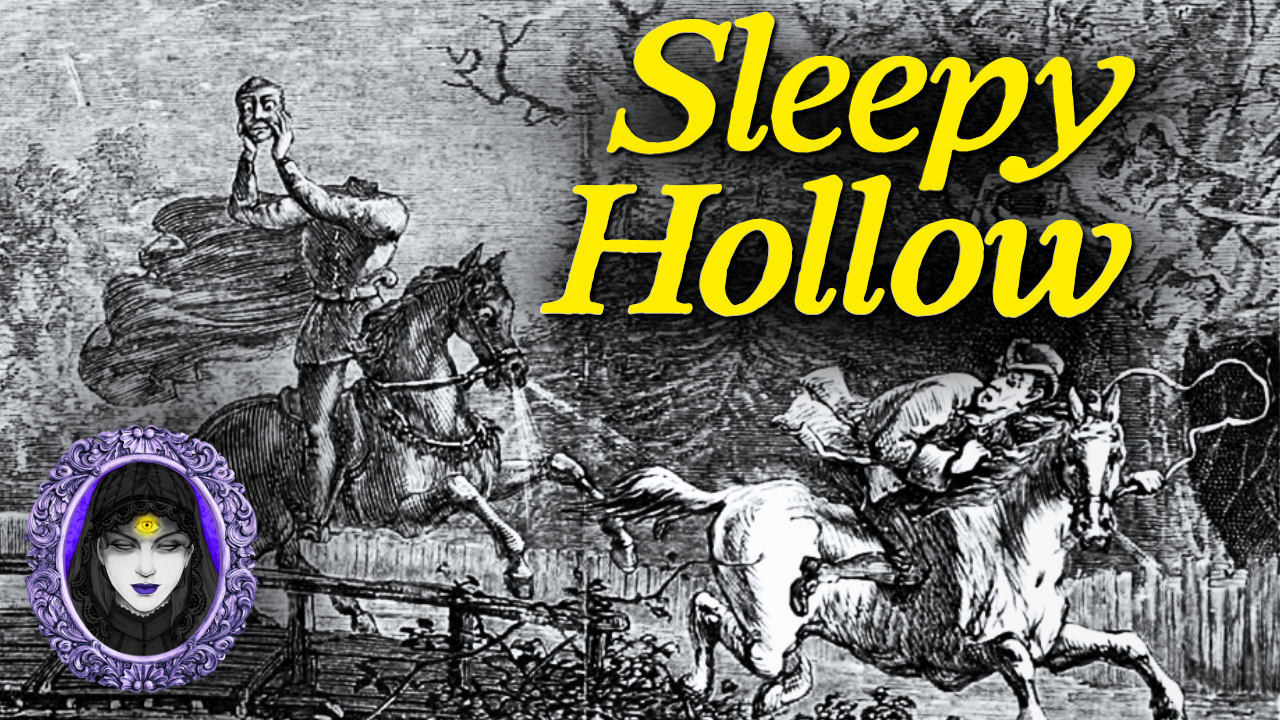
He throws his decapitated head at Ichabod and knocks him off of Gunpowder, and Ichabod was never heard from again. Dun dun dun.
But actually the book leaves it kind of vague. Was the Headless Horseman just Brom Bones pranking him, being kind of an asshole, but like, also he kind of deserved it? Like I'm kind of on Brom's side here, honestly. It's like they're pitting the geek and the jock against each other. I don't normally vote for the jock. Normally I'm rooting for the geek, right? But in this case, Ichabod's kind of a jerk. So I'm kind of with Brom on this one.
Who Was Ichabod Crane, Really?
He was actually named after a real person named Ichabod Crane that Washington Irving did actually meet in real life. Irving just heard the name Ichabod Crane, and he immediately wrote it down for a future story. He said, now that's a name.
Irving had a very good, and by good I mean weird, and by weird I mean strange, taste in names. Brom Bones, Ichabod Crane, Jeffrey Crayon, even his own name, Washington Irving. What is that?
He's a real guy, but Ichabod Crane's looks were not based on him. See what I mean? You don't write a, you're not writing a protagonist like that. Honestly, you're just not. But I'm here for it.
Ichabod Crane's superstitious belief--the reason that he's so easily spooked is that he always had his nose in a scary book such as The History of New England Witchcraft by Cotton Mather. In 1790, when the story is set, people weren't thinking about witch trials anymore. And he's supposed to be a school teacher, so why was he so superstitious? It's kind of weird and it feels like Irving was definitely doing it on purpose.
The Headless Horseman--What's a Hessian?
The dominant spirit that haunts this enchanted region, Sleepy Hollow, and seems to be commander in chief of all the powers of the air is the apparition of a figure on horseback without a head.
What's a Hessian? I didn't know going into this. Now I know a lot about it, and now you're about to know too.
Hessians were German auxiliary forces that were used during the American Revolution. The British actually ended up using more than 30,000 German troops during the Revolutionary War, and the Hessian soldiers made up about 1/4 of all the troops in the British Army, which is a lot.
The American colonists saw the Hessians as brutal, savage invaders. Americans in general were outraged at the idea of King George the Third hiring foreign troops to subdue them, and they specifically called out this practice in the Declaration of Independence. Some American riflemen were even found on Long Island impaled to trees by Hessian bayonets.
Americans were pissed about the Hessians. From what I can understand, they basically just considered it cheating. They considered that Great Britain was just cheating in the war by bringing in these German Hessian soldiers.
That's why the Headless Horseman in the story of the Legend of Sleepy Hollow--that's why he was a Hessian soldier.
The Pumpkin Wasn't Even a Jack O Lantern
So what you may famously remember about the Headless Horseman is a pumpkin or a Jack O Lantern, especially as his head, which is very scary. However, in Irving's time, a pumpkin was not yet a Halloween Jack O Lantern. Pumpkins didn't begin getting used for Jack O Lanterns until the 1840s, after the Irish Potato Famine forced many Irish to immigrate to America purely so they wouldn't starve to death. And then they found the native pumpkins to be much easier to carve and use as lanterns than the traditional turnip used in Ireland. Because imagine--have you tried to carve a turnip and do a Jack O Lantern? It's difficult. It's difficult, although the effect is much spookier.
No, the pumpkin that the Headless Horseman used was not in fact a Jack O Lantern. It was just a normal pumpkin. And also it would be something easy for Brom Bones to carry on the horse with him and then throw. I'm just saying--maybe it is a ghost, maybe it's Brom Bones, who knows.
Headless Horsemen Around the World
The one that seems like the most likely inspiration for Irving's Headless Horseman character is the German legend of Rubitzal. So anyway, the Rubitzal is probably the most likely to be the actual origin story for the Headless Horseman and the Legend of Sleepy Hollow.
Then we've also got the infamous German pirate Klaus Storta Baker. But we've also got the Irish Dullahan. Then yet another German myth, the Wild Huntsman. And why do the Germans have so many folklore stories about Headless Horsemen, I ask you. Then there's the Scottish, the Welsh, and the Indian myth Thakur Baba--a warrior who was decapitated mid battle but stayed on his horse and kept fighting. He was a good guy though.
If you know of any Headless Horseman myths in any other cultures other than European, then please let me know madamstrangeways@gmail.com.
Glowing Figure in Nagpur India | True Paranormal Stories & Spooky Folklore